Meditation: Meaning, Method, Mistakes, Benefits and the Path to Samādhi
A practical and source-aware guide to learning meditation correctly—mystical depth without exaggeration, and safety without reducing an ancient discipline to a wellness technique.
What is meditation?
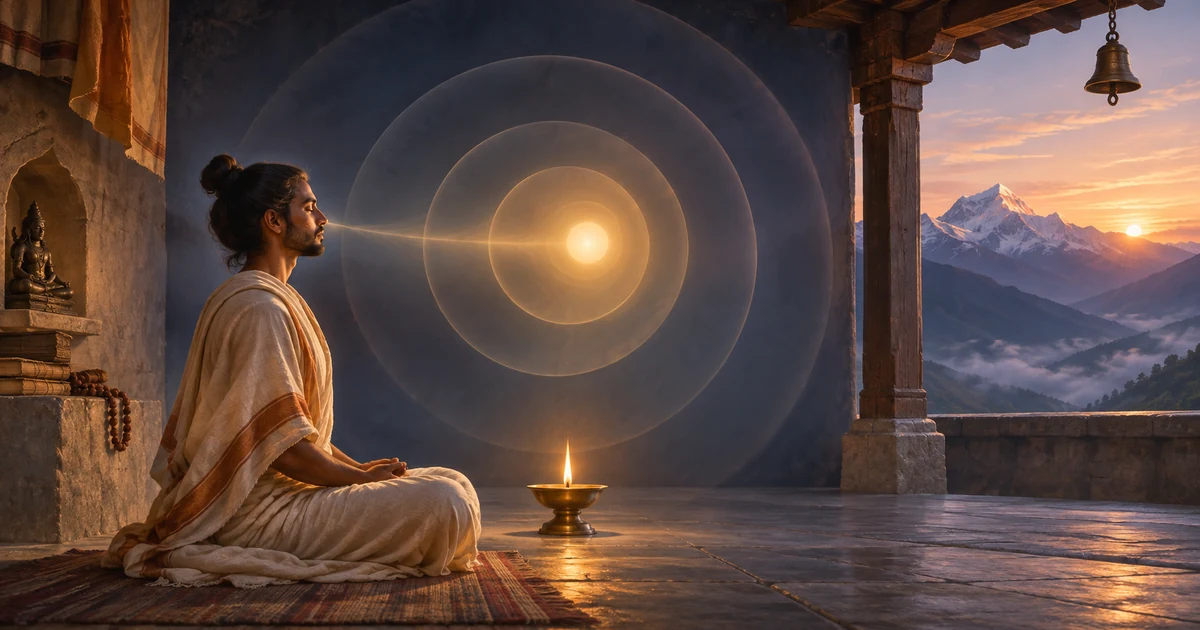
Meditation is sustained, undistracted awareness in which attention becomes steadier and the mind’s habitual movements are seen more clearly. In Patañjali’s Yoga, concentration (dhāraṇā) is fixing attention, meditation (dhyāna) is its continuous flow, and samādhi is absorption in which the object shines without the usual self-commentary. Meditation is therefore a trained process, not merely relaxation, blankness, visions or suppression of thought.
Direct answers to common questions
What is meditation in yoga?
Meditation in yoga (dhyāna, ध्यान) is an unbroken flow of attention towards one object, after concentration (dhāraṇā) has gathered the mind. Patañjali makes it the seventh of the eight limbs, leading to absorption (samādhi). It is a trained state of steady, clear awareness, not an empty mind or a mood of relaxation.
How do you start meditating?
Meditation starts with a steady, comfortable seat, an upright spine and natural breath. Choose one support — the breath, a mantra or a point of attention — and return to it gently whenever the mind wanders. Begin with ten minutes daily at the same time. Regularity matters more than length or special experiences.
What are the main types of meditation?
The main types of meditation are breath meditation (including so-ham), mantra and japa, trāṭaka gazing, visualisation of a deity or light, body and chakra awareness, the Vijñāna Bhairava dhāraṇās, self-inquiry, mindfulness and Swara meditation. They differ in their object; all aim at steady, clear, continuous attention.
What are the benefits of meditation?
The benefits of meditation, in research, include reduced anxiety, depression and stress and better coping with pain; in the tradition, clarity, steadiness, freedom from compulsive reactions and, finally, self-knowledge. Benefits grow with regular practice over months. Meditation is prescribed for the person and promises no cure; in some illnesses other practices come first.
Who should not meditate?
People in an acute psychotic or manic episode, or with severe depression, trauma flashbacks or panic that worsen in silence, should not do long silent meditation without guidance. They are often better served first by movement, dynamic breath, chanting and external focus. The Peeth adapts the method to the person.
Still have a question about Meditation (Dhyāna Yoga)? Ask in your own words; a teacher of the Peeth replies.
What the Shastra says
यतो यतो निश्चरति मनश्चञ्चलमस्थिरम् । ततस्ततो नियम्यैतदात्मन्येव वशं नयेत् ॥
yato yato niścarati manaścañcalamasthiram | tatastato niyamyaitadātmanyeva vaśaṃ nayet ||
Meaning: Wherever the restless, unsteady mind wanders, from there it should be drawn back and brought under the sway of the Self.
— Bhagavad Gītā 6.26 · Sanskrit text: Bhagavad Gītā mūla — Swara Yoga Peeth Sanskrit-primary corpus (sanskritdocuments.org edition)
The Gītā’s instruction is the whole technique in one line: wherever the restless mind goes, bring it back. Meditation is not the absence of wandering; it is the patient, repeated return.
देशबंधश्चित्तस्य धारणा।
deśabandhaścittasya dhāraṇā
Meaning: Concentration is the binding of the mind to a single place.
— Yoga Sūtra 3.1 · Sanskrit text: Patañjali, Yoga Sūtra — Swara Yoga Peeth Sanskrit-primary corpus
Patañjali names the first inner step precisely: binding attention to one place. Every method of meditation, whatever its object, begins here.
Why do we meditate?
Traditions give different but related purposes: to know the movements of mind, reduce compulsive reaction, cultivate discernment, become steady in ethical action, recognise awareness, deepen devotion, and prepare for liberation. Calm and improved attention may occur, but they are not the complete goal. A difficult sitting is not necessarily a failed sitting; seeing restlessness clearly can itself be part of practice.
Why can meditation paths differ and still lead toward truth?
Human beings share consciousness, breath and the capacity for attention, yet conditioning, temperament, devotion, inquiry and present needs differ. One person may enter through breath, another through mantra, sacred form, self-inquiry, service or open awareness. The object and method can differ while the movement from dispersion toward steadiness and clearer knowing remains recognisable.
The half-full and half-empty glass shows how attention and conditioning select a viewpoint. Meditation first reveals that selection, then develops the capacity to see the glass, the water, the observer and the arising judgment together. It does not make truth relative; it makes perception more complete.
Explore the path of meditation
Begin with the question most relevant to your practice: the meaning and purpose of meditation, a safe method, common difficulties, traditional sources, or the movement from concentration toward samādhi.
Understand
Practise
Safety and discernment
Texts and sources
How do I meditate step by step?
- Choose a quiet, reasonably safe place and a short, repeatable time.
- Sit upright without strain, on a chair or cushion; let the hands rest.
- Notice ordinary breathing. Do not deepen, hold or manipulate it.
- Choose one anchor: breath sensation, mantra, a sacred form, or open awareness according to your path.
- When attention wanders, recognise it without self-attack and return once.
- End gradually; feel the body, open the eyes and note the quality of mind.
- Practise regularly before increasing duration. Learn advanced breath, mantra or tantric dhāraṇā from a competent teacher.
The skill is returning, not forcing the mind to have no thoughts.
What is missing in my meditation?
Common missing foundations are ethical steadiness, realistic duration, a clear method, continuity, sleep and health support, and guidance appropriate to the person. Chasing a special state often creates more agitation. Patañjali pairs sustained practice (abhyāsa) with non-grasping (vairāgya); both are needed. In Swara practice, observing the unforced breath before technique can reveal whether effort is becoming strain.
Common meditation mistakes
- Trying to block every thought instead of learning to return.
- Using breath retention or force to manufacture an experience.
- Interpreting every sensation, image or emotion as spiritual attainment.
- Increasing duration despite insomnia, panic, dissociation or impaired daily functioning.
- Comparing experiences or accepting guaranteed-enlightenment claims.
- Using meditation instead of appropriate medical or psychological care.
Roots and sources of meditation
Yoga Sūtra 1.2 defines Yoga through the stilling of mental movements; 1.12 names practice and non-attachment; 2.29 lists the eight limbs; 3.1–3.3 distinguish dhāraṇā, dhyāna and samādhi.
Chapter 6 places meditation within disciplined living, posture, attention, moderation and repeated return of the wandering mind—not withdrawal from responsibility.
This Śaiva tantric text presents many dhāraṇās using breath, space, sound, sensation and awareness. Verse numbering and translation vary by edition; methods should be cited from a named edition and not detached from their context.
Buddhist, Jain, Sikh, Christian and Islamic contemplative traditions each have their own aims, language and disciplines. They can be compared respectfully, but should not be collapsed into one claim that all practices are identical or came from one source.
What does modern research say about meditation benefits?
Research on structured meditation programmes reports benefits for attention, stress, anxiety, pain, sleep and quality of life in particular populations, with results varying by method, dosage and study quality. This supports meditation as a serious field of practice and investigation. It also reinforces the traditional insight that method and individual condition matter: a group average cannot describe every practitioner or every contemplative path.
Where modern science meets this teaching
Meditation is one of the most researched contemplative practices. The evidence supports real, moderate benefits for stress, anxiety, depression and pain, alongside honest reports that some people meet difficulties — which is why method and guidance matter.
- Goyal M et al., JAMA Internal Medicine 2014 — meditation programmes for psychological stress and well-being (systematic review and meta-analysis, 47 trials, 3,515 participants). Mindfulness meditation programmes gave moderate evidence of improved anxiety, depression and pain, with small to moderate effects against active controls. Limit: Meditation was not better than other active treatments such as drugs or exercise, and evidence was weak for sleep, attention and positive mood.
- Farias M et al., Acta Psychiatrica Scandinavica 2020 — systematic review of adverse events in meditation (83 studies, 6,703 participants). Overall prevalence of adverse events was 8.3% (3.7% in experimental, 33.2% in observational studies); anxiety and depression were the most common. Limit: Pooled very different methods and excluded posture-based yoga; it cannot say which person or technique carries the risk.
- US National Center for Complementary and Integrative Health (NCCIH), “Yoga: Effectiveness and Safety”, last updated August 2023. Calls yoga generally safe for healthy people, notes help for neck pain, anxiety, depression and sleep, and asks pregnant women, older adults and people with conditions such as glaucoma or severe high blood pressure to consult their provider. Limit: A general public-health summary; it does not assess individual traditional methods such as kumbhaka or mudrā.
Who should modify or postpone meditation?
Most gentle practice is manageable for many people, but “everyone should simply meditate more” is unsafe advice. Pause intensive or unsupervised practice and seek qualified help when there is acute mania or psychosis, severe dissociation, suicidal thinking, uncontrolled panic, prolonged insomnia, substance withdrawal, or a medical emergency. Trauma-sensitive practice may use eyes open, movement, shorter sessions and external grounding.
A 2020 systematic review found reported meditation-related adverse events across somatic, psychiatric and cognitive categories; estimates varied greatly by study design. This calls for screening, dosage and competent support—not fear.
How meditation connects to Swara Yoga
Swara observation offers a gentle doorway: know the breath as it is before attempting to control it. The tradition associates balanced flow and moments of suṣumṇā with inwardness, but the practitioner should not force nostrils or chase a “central-channel” sensation. Breath awareness becomes a bridge from body and prāṇa to attention, while meditation reveals the mind that interprets every experience. Study the Swara meditation method and its relationship with natural nasal flow.
What is the right next step for you?
Courses suit people who want a steady, step-by-step practice with a teacher, online or at the ashram in Rishikesh. A general course is not the right first step for a specific health condition or an acute crisis; that needs practice prescribed for the person’s state.
Read next: What Is Meditation? Dhyāna, Concentration and Samādhi
Swami Charanashrit Giri · Swara Yoga Peeth, Rishikesh
Try this practice now
Reading about a practice and doing it are two different things. Sit for a few minutes with one of these guided recordings, spoken in the Peeth's own teaching voice. Headphones help; a quiet room is enough.
The Meeting of the Two Breaths
15 minWatch the place where the incoming and outgoing breaths meet, inside and outside — the Swara Yoga heart of the Vijñāna Bhairava. (Vijñāna Bhairava Tantra, śloka 64)
The Centre Where Breath Stands Still
15 minFind the natural pause where the breath neither goes out nor comes in, and stay there without thought. (Vijñāna Bhairava Tantra, śloka 26)
Swara Awareness — Watching the Breath Choose Its Nostril
10 minThe first practice of Swara Yoga: know which nostril flows, feel the breath's length, rest where both sides meet.
These recordings are part of a library of 112 Vijñāna Bhairava practices and teacher-led prāṇāyāma in the Swara Yoga app. To learn them in sequence, see our courses, or ask for guidance on which practice suits you.
If any practice brings dizziness, breathlessness or distress, stop, breathe normally and rest. Those who are pregnant, or living with high blood pressure, heart or lung disease, epilepsy or a psychiatric condition, learn breath practices with a teacher who adapts them.
Frequently asked questions
Am I doing meditation wrong because thoughts continue?
No. Noticing that attention wandered and returning without hostility is the foundational training. The measure is not instant absence of thought but growing continuity, clarity and freedom from automatic reaction. Persistent panic, insomnia or loss of functioning is different: shorten or pause the method and seek suitable guidance rather than forcing endurance.
Can meditation cure chronic disease?
Meditation may support stress regulation, coping, pain management or quality of life for some people, and individuals sometimes report profound recovery. A result in one person or one trial does not establish a universal cure. Use meditation as an individually adapted support and discuss treatment changes with the clinician responsible for the condition.
What is the difference between dhyan and meditation?
Dhyan is a common spelling of Sanskrit dhyāna. English “meditation” covers many practices, from relaxation to prayer and mindfulness. In Patañjali’s technical sequence, dhyāna means the increasingly uninterrupted flow of attention toward a chosen field after dhāraṇā has gathered the mind.
How long does it take to reach samadhi?
No honest teacher can promise a timetable because preparation, constitution, effort, previous conditioning, method and grace differ. The traditions emphasise ethics, long and uninterrupted practice, non-attachment and discernment. A dramatic experience is not a reliable certificate; greater stability, humility and freedom from compulsion are more trustworthy signs of integration.
Which meditation method is best for a beginner?
A simple method with one clearly defined anchor—natural breath, a suitable mantra, sacred form or external sound—is usually better than collecting techniques. The choice should reflect health, temperament and spiritual orientation. Begin briefly, observe the after-effect, and change the method if it increases panic, dissociation or instability.
Should everyone meditate in the same way?
No. Healthy beginners may use a general daily practice, while trauma, severe depression, mania, psychosis, pain or breath sensitivity can require movement, open eyes, external sound, shorter duration or postponement. Individual adaptation expresses Yoga’s precision; it does not weaken the path or divide people into spiritual successes and failures.
Is meditation the same as stopping thought?
No. The beginner trains recognition and return rather than attacking the mind. Yogic stillness is lucid and aware; forced suppression, fatigue, dullness and dissociation are different conditions. Useful thought remains necessary in daily life, while meditation changes identification with thought and the compulsion to follow every movement.
Why is a Guru or teacher useful?
A competent teacher preserves source, sequence and method, observes individual response and corrects effort or dosage. Guidance is especially valuable when breath, mantra, subtle perception or difficult experiences are involved. It should strengthen inquiry, direct observation and responsibility; secrecy, fear or demands for blind obedience contradict that purpose.
Sources and evidence
- Patañjali, Yoga Sūtra 1.2, 1.12–16, 2.29, 3.1–3.3.
- Bhagavad Gītā, chapter 6.
- Vijñāna Bhairava Tantra; use a named edition because numbering and translation differ.
- Farias M et al. “Adverse events in meditation practices and meditation-based therapies: a systematic review.” Acta Psychiatrica Scandinavica (2020). PubMed.
- NCCIH: Meditation and mindfulness—effectiveness and safety.
Talk to the Peeth about Meditation (Dhyāna Yoga)
Tell us about your health, your practice and what you are looking for; Swamiji or an Acharya will suggest a path suited to you. Or begin with the free seven-day Swara sheet.
Taught in the lineage of Swami Charanashrit Giri · Swara Yoga Peeth Sansthan, Swargashram, Rishikesh · This page awaits Swamiji’s review · Practice is prescribed for each person, according to their condition.
Learn meditation with a coherent method
Choose a current meditation course when available, or request a practice review. Health and crisis questions are referred appropriately and never turned into a sales diagnosis.