Muladhara Chakra — The Root Chakra of Yoga
What Is the Muladhara Chakra?
The Muladhara chakra is the root chakra, the first of the seven centres of the subtle body: a lotus of four petals at the base of the spine, the seat of the earth element and the resting place of kuṇḍalinī. This page explains the Muladhara chakra from the yoga and tantra śāstras — its place, its symbol, its bīja mantra, what it governs — and how the Swara Yoga tradition of Rishikesh steadies it through posture, breath, bandha and meditation.
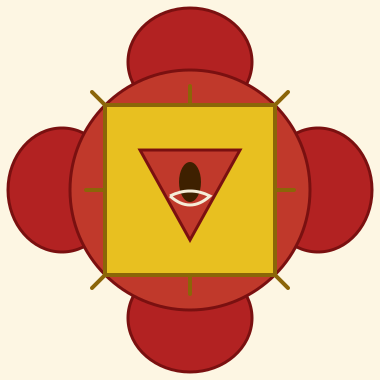
The meaning of the name Mūlādhāra
Mūla means root and ādhāra means support or foundation, so Mūlādhāra is the root support. It is called the root because the other centres rise from it, and the support because the whole body and the whole of practice rest on it. In English it is often called the root chakra.
The Ṣaṭ-cakra-nirūpaṇa of Pūrṇānanda, the classical description of the six centres, begins its account with this lotus. The Gorakṣa Śataka, the Śiva Saṃhitā and the Yoga Upaniṣads also name it as the first of the chakras on suṣumnā, the central nāḍī.
Where the Muladhara chakra is located
The texts place Mūlādhāra at the base of the spinal column, in the region between the anus and the genitals, at the lower end of suṣumnā. Just above it lies the kanda, the bulb-shaped centre from which, according to the haṭha yoga texts, the nāḍīs spread out through the body.
Like every chakra, it belongs to the subtle body and not to anatomy. The physical region at the base of the trunk is only the place where attention is gathered to find it. For this reason the scriptures speak of meditating on Mūlādhāra rather than of touching or pressing it, although mūla bandha works with the muscles of the same region.
The Muladhara Chakra at a Glance
The correspondences below follow the Ṣaṭ-cakra-nirūpaṇa and the general teaching of the tantra tradition.
| Meaning of the name | Root support |
|---|---|
| Place in the body | Base of the spine, between the anus and the genitals |
| Petals | Four, crimson, bearing the letters vaṃ, śaṃ, ṣaṃ and saṃ |
| Element (tattva) | Earth (pṛthvī) |
| Maṇḍala | A yellow square with eight spears |
| Bīja mantra | LAṂ |
| Vehicle of the bīja | The elephant Airāvata |
| Sense | Smell |
| Organ of action | Excretion (pāyu) |
| Presiding deity | The child Brahmā |
| Śakti | Ḍākinī |
| Vāyu | Apāna, the downward-moving prāṇa |
| Knot (granthi) | Brahma granthi |
| World (loka) | Bhūloka, the earthly plane |
Muladhara Chakra Symbol and Its Meaning
The symbol of the Muladhara chakra is not a modern logo but a picture for meditation, described piece by piece in the Ṣaṭ-cakra-nirūpaṇa. Each part points to something the yogi is meant to recognise within.
- The four petals: a crimson lotus with one letter of the Sanskrit alphabet on each petal. The letters show that sound, the root of mantra, is present even in the lowest centre.
- The square: the yellow maṇḍala of earth, the most solid of the five elements, with eight spears pointing to the directions. It stands for stability, boundaries and form.
- The elephant: Airāvata, the elephant of Indra, carries the bīja LAṂ. Its weight and patience show the strength of the earth element when it is steady.
- Brahmā and Ḍākinī: the creator, pictured as a child, and the śakti of this lotus, who governs the body's firm tissues. Together they show the power that gives the body its form.
- The triangle: a downward-pointing triangle in the centre of the square, called traipura. Within it stands the svayambhū liṅga, the self-born sign of Śiva.
- Kuṇḍalinī: coiled three and a half times around the liṅga, asleep, closing the entrance of suṣumnā with her mouth. She is the latent power of consciousness that yoga seeks to awaken.
What the Muladhara Chakra Governs
Because its element is earth, Mūlādhāra governs everything in a person that is solid and stable: the bones and the body's structure, the sense of smell, elimination through apāna vāyu, sleep, and the basic instinct to survive and be safe. On the level of the mind it is the root of trust, patience and the feeling of having a place in the world.
When the root centre is steady, a person is grounded and practical, sleeps and eats with regularity, can sit still in meditation and meets difficulty without panic. Practice built on such a foundation does not topple.
When it is unsettled, the signs are fear and insecurity, restlessness, a body that cannot settle into a posture, irregular habits, or the opposite — heaviness, dullness, greed and a clinging to possessions and routine. The tradition does not treat these as faults of a chakra to be repaired, but as signs that prāṇa and the mind need steadying from the ground up.
Kuṇḍalinī and the Muladhara Chakra
The Haṭha Yoga Pradīpikā opens its chapter on mudrās by saying that kuṇḍalinī is the support of all the practices of yoga, as the serpent king supports the earth. She rests in Mūlādhāra, and every method of haṭha yoga — āsana, prāṇāyāma, bandha and mudrā — is aimed at waking her and guiding her into suṣumnā.
Above the root lies the first of three knots, the Brahma granthi, which many teachers associate with this region. It stands for the pull of the body, of comfort and of the instinct for security, which holds awareness at the lowest level. Steady discipline loosens it; force does not.
The texts also teach that apāna, the downward-moving prāṇa, must be turned upward to meet prāṇa at the navel. This is the purpose of mūla bandha, which the Haṭha Yoga Pradīpikā describes in its third chapter: the heel presses the perineum, the root is contracted and apāna is drawn up.
How to Balance the Muladhara Chakra
In the Swara Yoga tradition the root centre is steadied first through the life of the practitioner and the breath, and only then through concentration on the chakra itself. The practices below are taught in that order.
- A regular life: fixed hours of sleep and food, simple sāttvika meals and time spent outdoors give the earth element its natural rhythm.
- A steady seat: siddhāsana, which the Haṭha Yoga Pradīpikā praises above all postures, or any seat that can be held still and comfortably.
- Standing and balancing āsanas: tāḍāsana, vṛkṣāsana and slow, firm movements that bring awareness down into the legs and feet.
- Nāḍī śodhana: alternate-nostril breathing that calms fear and balances iḍā and piṅgalā.
- Mūla bandha and aśvinī mudrā: gentle contraction of the root region, learnt from a teacher and never strained.
- Mantra: repetition of the bīja LAṂ, slowly and with attention resting at the base of the spine.
- Yama and niyama: non-greed (aparigraha), contentment (santoṣa) and steadiness in one's duties remove the fear that unsettles the root.
Practise gently and regularly. Bandhas and long breath retentions should be learnt from a qualified teacher, and anyone with high blood pressure, heart disease, pregnancy, haemorrhoids, a recent abdominal operation or a history of mental illness should seek advice first. Chakra practice is a spiritual discipline and is not a substitute for medical care.
A Simple Muladhara Chakra Meditation
This short meditation is suitable for beginners. It uses only attention, breath and the bīja, and can be practised for ten to fifteen minutes each morning.
- Sit in a steady, comfortable posture with the spine upright and the hands resting on the knees.
- Close the eyes and breathe slowly through the nose until the breath is calm and even.
- Bring your attention to the base of the spine and feel the contact of the body with the ground.
- Picture there a yellow square, solid and still, surrounded by four crimson petals.
- Repeat the bīja LAṂ silently with each exhalation, letting the sound rest in the square.
- Feel the body become heavy, stable and safe, like a mountain resting on the earth.
- Let the image go, sit quietly for a few breaths, and open the eyes slowly.
The Muladhara Chakra in Swara Yoga
The Śiva Svarodaya, the root text of Swara Yoga, teaches that the five elements are present in the breath as well as in the body, and that earth is the element of steadiness. Swara Yoga therefore approaches the root centre through awareness of the breath, not through imagination alone.
A student of the Swara Yoga Peeth first learns to observe the breath, to know which nostril is flowing and to sit still. When the breath is calm and the body is steady, attention at Mūlādhāra rests on a real foundation. How the elements are recognised in the breath is learnt in person from the teacher.
Common Misunderstandings about the Muladhara Chakra
- The colour of the root chakra is often given simply as red. In the Ṣaṭ-cakra-nirūpaṇa the petals are crimson, but the square of earth at its heart is yellow.
- Linking Mūlādhāra with the adrenal glands or a nerve plexus is a modern comparison. It can help study, but the scriptures describe the chakra in the subtle body.
- The root chakra is not lower in value than the others. Every higher stage of practice rests on the stability it provides.
- Awakening kuṇḍalinī is not a quick experience to be chased. The scriptures place it at the end of a long sādhanā of purification, discipline and devotion.
Frequently Asked Questions about the Muladhara Chakra
What does Muladhara mean?
Mūla means root and ādhāra means support. Mūlādhāra is the root support, the foundation on which the body and every other chakra rest.
Where is the Muladhara chakra located?
At the base of the spine, in the region between the anus and the genitals, at the lower end of suṣumnā nāḍī.
What is the bīja mantra of the Muladhara chakra?
LAṂ, the seed syllable of the earth element. It is repeated slowly with attention resting at the base of the spine.
What is the element of the root chakra?
Earth (pṛthvī), shown as a yellow square. Its sense is smell and its quality is stability.
What are the signs of an unbalanced Muladhara chakra?
Fear, insecurity, restlessness and irregular habits, or the opposite: heaviness, dullness and clinging to possessions. Both call for steadiness of life, breath and mind.
How can I balance the Muladhara chakra?
Keep regular hours, sit in a steady posture, practise nāḍī śodhana, learn mūla bandha from a teacher, and meditate at the base of the spine with the bīja LAṂ.
Is kuṇḍalinī really asleep in the Muladhara chakra?
The scriptures describe her so, coiled three and a half times and asleep at the root. They also say she is awakened by purification, discipline and grace, never by force.
सशैलवनधात्रीणां यथाधारोऽहिनायकः । सर्वेषां योगतन्त्राणां तथाधारो हि कुण्डली ॥
As the lord of serpents supports the earth with its mountains and forests, so kuṇḍalinī is the support of all the practices of yoga.
— Haṭha Yoga Pradīpikā 3.1
Build the foundation
Learn the postures, bandhas and breathing that steady the root centre, step by step, with Swara Yoga Peeth, Rishikesh.
7 Chakras The Three Bandhas Pranayama Nadi & Tattva CoursesPublished 2 November 2026. Reviewed by Swara Yoga Peeth, Rishikesh; next review May 2027.