Svadhisthana Chakra: The Water Centre of Adaptation and Desire
The six-petalled centre explained through its Sanskrit sources, element, bīja, emotional meaning, Swara relationship and individually suitable practice.
Svadhisthana Chakra
Svādhiṣṭhāna is the second centre in the common six-chakra tantric map. The Ṣaṭ-cakra-nirūpaṇa describes a six-petalled lotus with the water maṇḍala and bīja VAṂ. Its symbolism concerns flow, cohesion, taste, desire, memory and adaptability. It is not merely a modern label for sexuality, and physical or emotional symptoms cannot be diagnosed from a chakra chart alone.
Direct answers to common questions
What is the Svadhisthana chakra?
The Svadhisthana chakra is the second chakra, at the genital region, a six-petalled lotus of the water element with the seed syllable vaṃ. Its name means “one’s own abode”: the Gorakṣaśataka explains that “sva” means prāṇa, so it is the seat of prāṇa. It governs flow, desire, creativity and relationship.
Which letters are written on the six petals of Svadhisthana?
Ṣaṭ-cakra-nirūpaṇa 14 gives the six letters from Ba to La with bindu: बं, भं, मं, यं, रं, लं. Our diagram begins at the top or eastern petal and proceeds clockwise, with one verified syllable typeset at each petal centre. This makes both the sequence and the placement open to inspection.
Where is the Svadhisthana chakra located?
Svadhisthana is located at the root of the genital organ, above mūlādhāra and below the navel. The Gorakṣaśataka names the meḍhra (genital region) as its place. In practice, attention rests in the lower abdomen and pelvic floor, a little above the base of the spine.
What element and bija belong to Svadhisthana?
Svadhisthana belongs to the water element (apas), shown in the Ṣaṭ-cakra-nirūpaṇa as a white half-moon within the six-petalled lotus. Its bīja is vaṃ, the seed of Varuṇa. Its deity is Viṣṇu and its Śakti Rākiṇī. Water’s qualities — flowing, cohesive, nourishing — describe the centre’s work.
What are signs of imbalance in Svadhisthana?
In the tradition, imbalance at Svadhisthana shows as restless craving, emotional flooding, or the opposite: dryness, low creativity and withdrawal from relationship. These are descriptions for self-reflection, not diagnoses. Health symptoms in the pelvic region — pain, bleeding, urinary problems — always need medical assessment.
How do you practise for the Svadhisthana chakra?
Svadhisthana is approached through gentle hip-opening āsanas, pelvic-floor awareness, relaxed abdominal breathing, soft chanting of vaṃ, and reflection on desire and creativity. Swara Yoga adds noticing the breath during moments of craving. Strong bandhas and vajrolī-type practices belong only with a qualified teacher.
Still have a question about Svadhisthana Chakra? Ask in your own words; a teacher of the Peeth replies.
Svādhiṣṭhāna at a glance
Values from the Ṣaṭ-cakra-nirūpaṇa (Pūrṇānanda), Avalon edition 1919, with the Gorakṣaśataka where it differs.
| Feature | In the texts |
|---|---|
| Location | Genital region (meḍhra), above mūlādhāra |
| Petals | 6 |
| Element | Water — white half-moon maṇḍala |
| Bīja | Vaṃ (Varuṇa-bīja) |
| Deity · Śakti | Viṣṇu · Rākiṇī |
| Name explained | “Sva” = prāṇa; its seat (Gorakṣaśataka 14) |
What the Shastra says
सिन्दूरपूररुचिरारुणपद्ममन्यत्सौषुम्णमध्यघटितं ध्वजमूलदेशे । अङ्गच्छदैः परिवृतं तडिदाभवर्णैर्बाद्यैः सबिन्दुलसितैश्च पुरन्दरान्तैः ॥
sindūrapūrarucirāruṇapadmamanyatsauṣumṇamadhyaghaṭitaṃ dhvajamūladeśe | aṅgacchadaiḥ parivṛtaṃ taḍidābhavarṇairbādyaiḥ sabindulasitaiśca purandarāntaiḥ ||
Meaning: At the root of the genitals is another vermilion lotus within Suṣumṇā. Its six petals bear the lightning-bright letters from Ba to La, each with bindu: Ba, Bha, Ma, Ya, Ra and La.
— Ṣaṭ-cakra-nirūpaṇa, verse 14 · Sanskrit text: Pūrṇānanda, Ṣaṭ-cakra-nirūpaṇa — Sanskrit text and Kālīcaraṇa commentary in Arthur Avalon's 1919 edition
The verse places the six-petalled vermilion lotus within Suṣumṇā and gives its Ba-to-La sequence with bindu.
स्वशब्देन भवेत्प्राणः स्वाधिष्ठानं तदाश्रयः । स्वाधिष्ठानाख्यया तस्मान् मेढ्रमेवाभिधीयते ॥
sva-śabdena bhavet prāṇaḥ svādhiṣṭhānaṃ tad-āśrayaḥ | svādhiṣṭhānākhyayā tasmān meḍhram evābhidhīyate ||
Meaning: By the word “sva” prāṇa is meant; svādhiṣṭhāna is its seat. Hence the region of the generative organ is called svādhiṣṭhāna.
— Gorakṣaśataka, verse 14 · Sanskrit text: Gorakṣaśataka — GRETIL e-text (Göttingen) of the critical edition by Swami Kuvalayananda and S. A. Shukla (Kaivalyadham, Lonavla)
The name is explained, not just stated: “sva” means prāṇa, and this is its seat. Svādhiṣṭhāna is therefore about the life-force in its creative, flowing form, not only about desire.
स्वाधिष्ठानं द्वितीयं तु सन्माणिक्यसुशोभनम् । नासाग्रे दृष्टिमादाय ध्यात्वा मुञ्चति पातकम् ॥
svādhiṣṭhānaṃ dvitīyaṃ tu san-māṇikya-suśobhanam | nāsāgre dṛṣṭim ādāya dhyātvā muñcati pātakam ||
Meaning: The second, svādhiṣṭhāna, shines like a fine ruby; fixing the gaze at the tip of the nose and meditating on it, one is released from wrongdoing.
— Gorakṣaśataka, verse 79 · Sanskrit text: Gorakṣaśataka — GRETIL e-text (Göttingen) of the critical edition by Swami Kuvalayananda and S. A. Shukla (Kaivalyadham, Lonavla)
The second centre is to be meditated on as shining like a ruby, with the gaze steady. Concentration on the centre is itself the purifying practice.
Name, location and textual setting
Sva means one’s own; adhiṣṭhāna means seat, foundation or abiding place. English pages often call it the sacral chakra, but classical descriptions use their own subtle-body landmarks. It is placed above Mūlādhāra and below Maṇipūra along suṣumṇā. Like every chakra, it belongs to a contemplative map rather than a structure found by dissection.
The six-petalled lotus and water mandala
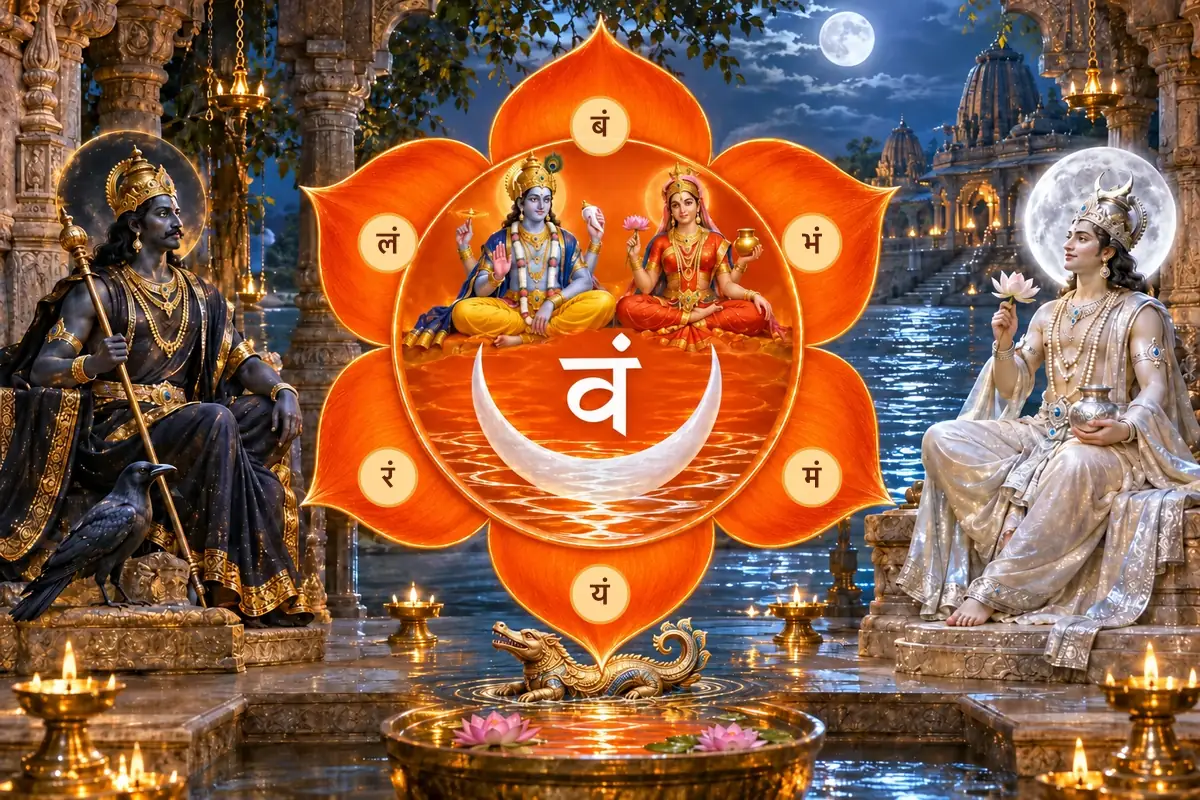
The lotus has six petals bearing Sanskrit letters and contains the region of water, commonly represented by a crescent. The bīja is VAṂ; Varuṇa is associated with the water principle, and Rākiṇī is the śakti named in the lotus. Modern orange imagery can be useful as a teaching convention, but it should not be mistaken for the only scriptural description.
Water, taste and the power to relate
Water takes the shape of its vessel while retaining continuity. Svādhiṣṭhāna therefore gives a language for emotional movement, pleasure, aversion, intimacy, imagination and the capacity to adapt. Balanced flow is neither repression nor uncontrolled indulgence. It is the ability to feel and respond without being carried away.
Samskara, desire and creativity
Later teaching often connects this region with latent impressions and the pull of desire. The point is not that every memory is stored in a literal pelvic container. It is that unexamined impressions shape attraction, repetition and creative energy. Svādhyāya, restraint and devotion help transform this energy rather than merely suppressing it.
Signs that practice needs rebalancing
Compulsive sensation-seeking, emotional flooding, shame, numbness or creative stagnation may be contemplated through this centre, but none proves a chakra diagnosis. Hormonal, reproductive, urinary, digestive and mental-health concerns have many causes. Yoga can provide one interpretive and practical layer while appropriate care addresses others.
Suitable practice is different for each person
A stable healthy student may use gentle hip movement, pelvic awareness, natural abdominal breathing, mantra and creative discipline. Someone with trauma, pelvic pain, pregnancy, recent surgery or overwhelming emotion needs a different entry, often beginning with feet, boundaries, walking and external support rather than prolonged inward focus on the pelvis.
A gentle Svadhisthana contemplation
Sit supported. Feel the ground and the whole body first. Let the lower abdomen move naturally with breath. On exhalation, repeat VAṂ softly or mentally without retention. Notice whether attention becomes calmer and more fluid; do not manufacture heat, arousal or imagery. After several rounds, feel the feet and open the eyes.
From Muladhara stability to Manipura transformation
The chakra map is relational. Mūlādhāra gives support; Svādhiṣṭhāna allows movement and contact; Maṇipūra transforms what has been received. Flow without ground becomes unstable, while ground without flow becomes rigid. A practitioner therefore does not isolate the second centre from feet, digestion, conduct and the rest of the subtle path.
In everyday life this relationship can be tested without mystical display. Can pleasure be enjoyed without compulsion? Can disappointment move without becoming identity? Can creative energy take form through disciplined action? These questions reveal more than trying to manufacture a colour or vibration. The centre becomes balanced as feeling, boundary and purposeful movement learn to cooperate.
Desire is transformed, not made an enemy
Yoga does not succeed by pretending desire does not exist. Desire contains information and energy, but it becomes binding when the mind cannot examine or redirect it. Brahmacarya, moderation and self-study are not hatred of the senses; they protect vitality from unconscious repetition. Devotion can turn longing toward the sacred, while art, relationship and service give it truthful expression.
This is why no single posture “opens” Svādhiṣṭhāna. The practice includes how a person eats, consumes media, forms intimacy, responds to loneliness and keeps commitments. Subtle purification becomes visible in choices.
Where modern science meets this teaching
The pelvic region that the tradition links with svādhiṣṭhāna is one of the few areas where targeted yoga has been tested in trials. The results support yoga as a useful option, without making it a cure-all.
- Huang AJ et al., Annals of Internal Medicine 2024 — 12-week pelvic-floor yoga vs physical conditioning for urinary incontinence in women aged 45–90 (randomised, n = 240). Daily incontinence episodes fell by 2.3 with pelvic yoga and by 1.9 with general stretching and strengthening. Limit: Pelvic yoga was not superior to the conditioning programme, and there was no untreated comparison group.
- Kannan P et al., Complementary Therapies in Clinical Practice 2021 — yoga, Pilates and pelvic-floor training for incontinence in women over 60 (randomised pilot, n = 30). All three programmes improved continence scores over 12 weeks; yoga poses for the pelvic floor and core did better than Pilates. Limit: A small pilot randomised by care centre; larger trials are needed.
How this connects to Swara Yoga
Water corresponds to a particular tattvic quality in Swara teaching, but one observation is not a diagnosis. The practitioner notices whether breath is smooth, heavy, restless or balanced and how emotional flow changes with left, right and central conditions. Swara makes the inquiry dynamic: the same person does not remain in one elemental state all day.
Learn the five tattvas in the breath · Understand Chakra Shuddhi before activation
Practice, guidance and health
Keep breath natural and avoid forceful pelvic locks, long retention or emotionally intense visualisation without guidance. Pelvic pain, bleeding, reproductive or urinary symptoms require appropriate assessment. Trauma-related dissociation, panic or loss of function calls for grounding and trauma-informed support rather than deeper inward pressure.
What is the right next step for you?
This guided purification suits people who want to work with the chakras gradually, beginning with shuddhi before any activation. It does not promise instant opening or a guaranteed result; practice is prescribed for the person.
Read next: Manipura Chakra
Swami Charanashrit Giri · Swara Yoga Peeth, Rishikesh
Frequently asked questions
Is Svadhisthana the sacral chakra?
Yes. In modern English it is often called the sacral chakra, after the sacrum, though the texts place it at the root of the genital organ rather than at the bone itself. Both names point to the same centre between the base and the navel, governed by water.
Is Svadhisthana linked with sexuality?
Yes, among other things. The centre governs reproductive energy, pleasure and desire, and also creativity, emotional flow and intimacy. The tradition does not condemn desire; it teaches that desire can be refined and directed. Ethical relationships and moderation are the ground of practice here.
What mantra is chanted for Svadhisthana?
The seed vaṃ is chanted softly, on the exhalation, with attention resting in the lower abdomen. Some lineages also use a deity mantra of Viṣṇu or the Śakti Rākiṇī given in initiation. Chanting should feel calming; if it brings agitation, shorten it and return to plain breath awareness.
Which asanas support Svadhisthana?
Gentle hip openers such as baddha koṇāsana and supported squats, pelvic tilts, bhujaṅgāsana, and seated postures with an upright spine are commonly used. People with back or pelvic conditions need adapted versions. The aim is comfort and awareness in the pelvis, not extreme flexibility.
How does water in daily life relate to Svadhisthana?
The tradition sees the water element in the body’s fluids, in taste and in emotional flow. Adequate drinking water, fresh food, rest and time near water are simple supports. Swara Yoga recognises the water tattva in the breath by its quality; noticing it builds sensitivity to this centre.
Can Svadhisthana practice help with emotions?
Many practitioners find that breath awareness and reflection at this centre help them notice emotional waves before being carried away by them. That is the traditional aim — flow without flooding. Persistent depression, trauma or anxiety call for practice prescribed for that state — movement and dynamic breath before inward work — and many people also choose a therapist; practice should be adapted accordingly.
Sources
- Ṣaṭ-cakra-nirūpaṇa, verses describing Svādhiṣṭhāna, checked in a named Sanskrit edition.
- Śiva Saṃhitā and Yoga Upaniṣad chakra accounts, noting their differences.
- Śiva Svarodaya for the water tattva within Swara practice.
- US NCCIH, Yoga: What You Need to Know.
- Ṣaṭ-cakra-nirūpaṇa, verse 14 — Pūrṇānanda, Ṣaṭ-cakra-nirūpaṇa — Sanskrit text and Kālīcaraṇa commentary in Arthur Avalon's 1919 edition.
- Gorakṣaśataka, verse 14 — Gorakṣaśataka — GRETIL e-text (Göttingen) of the critical edition by Swami Kuvalayananda and S. A. Shukla (Kaivalyadham, Lonavla).
- Gorakṣaśataka, verse 79 — Gorakṣaśataka — GRETIL e-text (Göttingen) of the critical edition by Swami Kuvalayananda and S. A. Shukla (Kaivalyadham, Lonavla).
- Huang AJ et al., Annals of Internal Medicine 2024 — 12-week pelvic-floor yoga vs physical conditioning for urinary incontinence in women aged 45–90 (randomised, n = 240).
- Kannan P et al., Complementary Therapies in Clinical Practice 2021 — yoga, Pilates and pelvic-floor training for incontinence in women over 60 (randomised pilot, n = 30).
Talk to the Peeth about Svadhisthana Chakra
Tell us about your health, your practice and what you are looking for; Swamiji or an Acharya will suggest a path suited to you. Or begin with the free seven-day Swara sheet.
Taught in the lineage of Swami Charanashrit Giri · Swara Yoga Peeth Sansthan, Swargashram, Rishikesh · This page awaits Swamiji’s review · Practice is prescribed for each person, according to their condition.
Continue your study
Explore the complete Seven Chakras teaching, see current courses, or ask which form of guidance suits your experience and safety needs.