Anahata Chakra: The Heart Centre and Unstruck Sound
Anāhata through scripture, devotion, breath and lived relationship—without reducing the spiritual heart to anatomy or sentimental slogans.
Anahata Chakra
Anāhata means “unstruck” and names the twelve-petalled heart centre associated with air, the bīja YAṂ, touch, devotion, relationship and inner sound. It is a subtle contemplative centre, not the anatomical heart. Practice may support compassion, courage, grief integration and devotion, while chest pain, heart disease and other medical symptoms still require appropriate clinical assessment.
Direct answers to common questions
What is the Anahata chakra?
The Anahata chakra is the fourth chakra, at the heart, a twelve-petalled lotus of the air element with the seed syllable yaṃ. Anāhata means “unstruck”: the inner sound heard here arises without any striking. The Gorakṣaśataka says the yogis know the cakra in the heart as anāhata, where the threefold-bound bull roars.
Where is the Anahata chakra?
Anahata is in the centre of the chest, at the level of the heart, along the central channel rather than on the left side where the physical heart lies. The Ṣaṭ-cakra-nirūpaṇa calls it the heart lotus. Practitioners rest attention in the middle of the chest, behind the breastbone.
What does an open heart chakra mean?
An open heart chakra, in traditional terms, means love, compassion and devotion flowing without the knots of attachment and fear. Many teaching lineages contemplate Viṣṇu Granthi through the navel-to-heart field, while Lalitā Sahasranāma 38 explicitly names its piercing as Kuṇḍalinī rises in Maṇipūra. Its loosening widens love beyond “mine”; the sign is steady kindness, not a passing emotional high.
What is Bana or Vana Linga in the Anahata chakra?
Bāṇa Liṅga—written Bana, and reproduced as Vana Linga in some older English material—is the golden Śiva-liṅga placed inside Anāhata’s downward triangle by Ṣaṭ-cakra-nirūpaṇa 25. A crescent and bindu crown it. It marks Śiva present within the heart, where personal feeling can become devotion, inward sound and awareness wider than “mine”.
Still have a question about Anahata Chakra? Ask in your own words; a teacher of the Peeth replies.
Anāhata at a glance
Values from the Ṣaṭ-cakra-nirūpaṇa (Pūrṇānanda), Avalon edition 1919, with the Gorakṣaśataka where it differs.
| Feature | In the texts |
|---|---|
| Location | Heart region, centre of the chest (Gorakṣaśataka 60) |
| Petals | 12, letters ka to ṭha |
| Element | Air — smoky hexagonal maṇḍala |
| Bīja | Yaṃ (pavana-bīja, Kālīcaraṇa) |
| Liṅga | Golden Bāṇa Liṅga within the triangle, crowned by crescent and bindu (Ṣaṭ-cakra-nirūpaṇa 25) |
| Granthi field | Many teaching lineages explain Viṣṇu Granthi through the navel-to-heart passage; Lalitā Sahasranāma 38 names its piercing as Kuṇḍalinī rises in Maṇipūra |
| Deity · Śakti | Īśa · Kākinī; jīvātmā like a steady flame within |
| Name explained | “Unstruck” — the inner sound (anāhata nāda) |
What the Shastra says
एतन्नीरजकर्णिकान्तरलसच्छक्तिस्त्रिकोणाभिधा । विद्युत्कोटिसमानकोमलवपुः सास्ते तदन्तर्गतः ॥ बाणाख्यः शिवलिङ्गकोऽपि कनकाकाराङ्गरागोज्ज्वलो । मौलौ सूक्ष्मविभेदयुङ्मणिरिव प्रोल्लासलक्ष्म्यालयः ॥
etannīrajakarṇikāntaralasacchaktistrikoṇābhidhā | vidyutkoṭisamānakomalavapuḥ sāste tadantargataḥ || bāṇākhyaḥ śivaliṅgako'pi kanakākārāṅgarāgojjvalo | maulau sūkṣmavibhedayuṅmaṇiriva prollāsalakṣmyālayaḥ ||
Meaning: In the pericarp of this lotus is Śakti in triangular form, tender as ten million flashes of lightning. Within her is the Śiva-liṅga named Bāṇa, radiant like shining gold, bearing at his crown a minute opening like that of a gem, an abode of splendour.
— Ṣaṭ-cakra-nirūpaṇa, verse 25 · Sanskrit text: Pūrṇānanda, Ṣaṭ-cakra-nirūpaṇa — orthography normalised from the Sanskrit text and Kālīcaraṇa commentary in Arthur Avalon's 1919 edition
Pūrṇānanda locates Bāṇa Liṅga inside the heart lotus’s triangle. Golden brilliance, the crescent and bindu, and the minute opening at its crown make it a symbol of consciousness becoming inwardly radiant and permeable.
विद्युत्प्रभावं हृत्पद्मे प्राणायामविभेदनैः । नासाग्रे दृष्टिमादाय ध्यात्वा ब्रह्ममयो भवेत् ॥
vidyut-prabhāvaṃ hṛt-padme prāṇāyāma-vibhedanaiḥ | nāsāgre dṛṣṭim ādāya dhyātvā brahma-mayo bhavet ||
Meaning: In the heart lotus, radiant like lightning, opened by the methods of prāṇāyāma — fixing the gaze at the nose-tip and meditating there, one becomes full of Brahman.
— Gorakṣaśataka, verse 82 · Sanskrit text: Gorakṣaśataka — GRETIL e-text (Göttingen) of the critical edition by Swami Kuvalayananda and S. A. Shukla (Kaivalyadham, Lonavla)
The heart lotus shines like lightning when prāṇāyāma has opened it, and meditation there makes one “full of Brahman”. Breath and devotion meet at this centre.
Why the centre is called Anahata
Āhata is struck; anāhata is unstruck. The name directs attention from external noise toward a subtler resonance of consciousness. It does not mean that every ringing sound is mystical; tinnitus and auditory symptoms have ordinary clinical causes that deserve assessment.
The twelve-petalled symbol
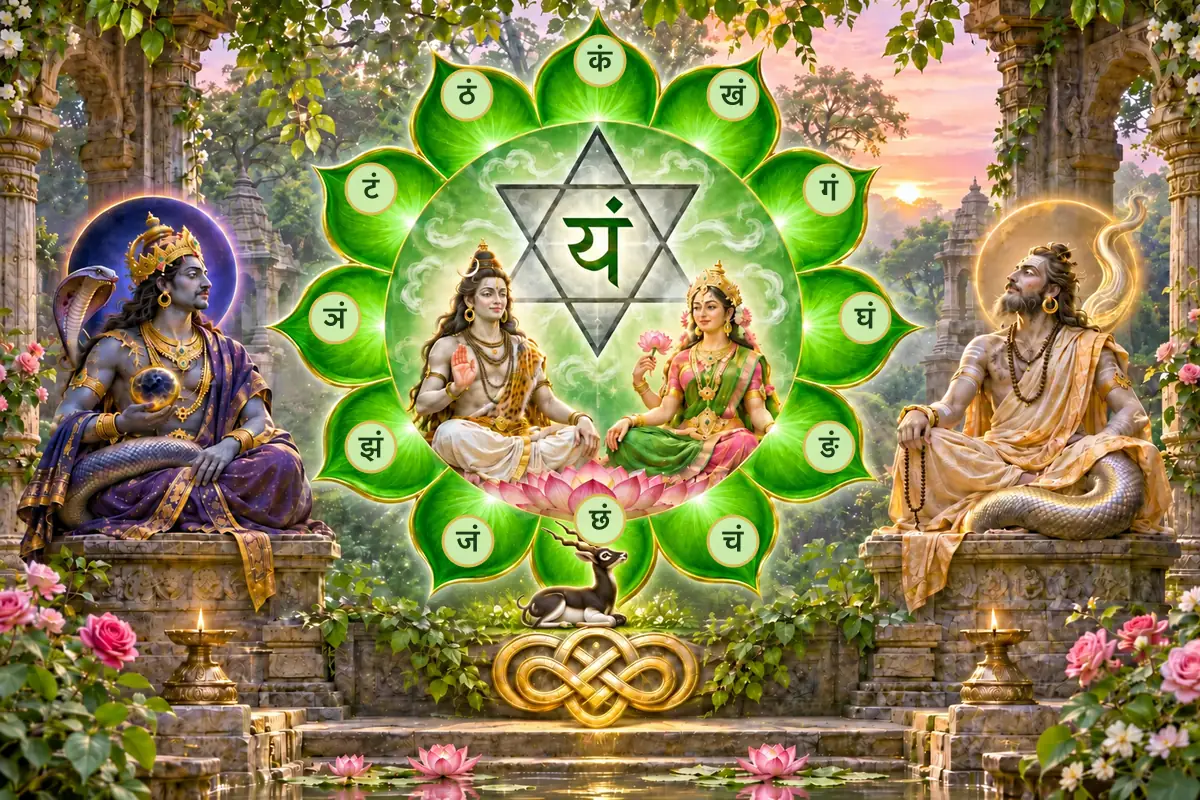
The classical lotus has twelve petals and contains the air maṇḍala, often shown with intersecting triangles. YAṂ is the bīja in the familiar textual presentation; Īśa and Kākiṇī are named within the centre. Modern green colouring is a later convention and should be distinguished from source-specific imagery.
Bāṇa Liṅga within Anāhata
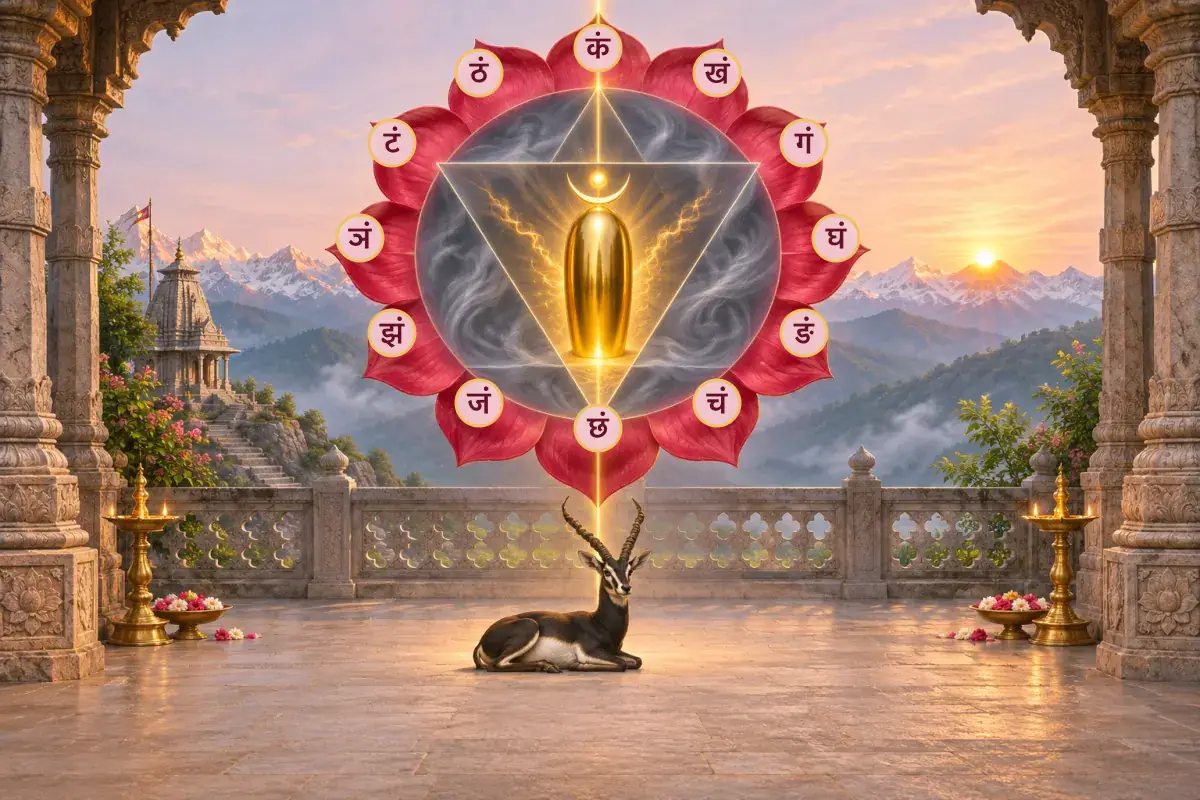
The Ṣaṭ-cakra-nirūpaṇa places the radiant golden Bāṇa Liṅga, crowned by crescent and bindu, in Anāhata’s downward triangle. This sacred form of Śiva signifies feeling refined into devotion, inner sound and wider awareness within the subtle map.
Air, touch and relationship
Air moves, connects and permits exchange. Breath continuously crosses the apparent border between inner and outer. The sense of touch similarly reveals contact and boundary. Anāhata therefore becomes a powerful field for love that is neither possession nor withdrawal: openness supported by discrimination.
Love, grief and devotion
A living heart can love and grieve. Chakra language should not be used to blame someone for bereavement, loneliness or trauma. Bhakti, prayer, service and trustworthy relationship can give grief a sacred and human container. Sometimes the right practice is not more inward meditation but food, sleep, movement and the presence of another person.
Prana Vayu and the chest region
Traditional vital-wind maps associate prāṇa-vāyu with the chest and receiving function. This is not a substitute for respiratory anatomy. Gentle breath can make the region more available to awareness, while aggressive expansion, breath retention or repeated maximal inhalation may create dizziness or anxiety.
A safe Anahata practice
Sit with the back supported if needed. Place a hand lightly over the centre of the chest and breathe normally. On each exhalation repeat YAṂ, a prayer or a name of the Divine that belongs to your path. Let one quality—kindness, courage, forgiveness or truthfulness—become a practical action after meditation.
When heart-centre meditation is not the first step
For some trauma survivors, concentrating on the chest intensifies panic or painful memory. Begin instead with eyes open, feet on the floor, orienting to the room and gentle walking. A teacher should change the method to the person rather than declaring resistance to be spiritual failure.
The heart stands between lower and upper centres
Anāhata occupies the middle of the familiar seven-centre map. Below it, earth, water and fire emphasise support, flow and transformation; above it, space, mind and transcendence become more prominent. The heart does not reject either direction. It lets embodied life and subtle awareness meet through relationship, breath and devotion.
This central position explains why “opening the heart” cannot mean losing boundaries. Air needs space but also rhythm; love needs openness and discrimination. A mature heart can say yes, no, stay, leave, forgive or seek justice without abandoning compassion.
Anahata Nada and the discipline of listening
Inner sound practices belong to a wider path of nāda and absorption. A practitioner first becomes capable of listening: to breath, mantra, another person and the silence between impulses. Chasing an internal sound can create tension or suggestion. The unstruck is approached as the mind becomes less noisy, not by pressing the ears or demanding an experience.
When devotion is present, listening becomes surrender rather than passivity. The practitioner does not become empty of intelligence; personal insistence softens enough for a wiser response to appear. The fruit is tested in relationship: patience deepens, speech becomes less injurious and care becomes more capable of wise action.
Where modern science meets this teaching
The heart centre’s practices — slow breath, chanting and devotion — have measurable effects on heart rhythm and blood pressure, a meeting point the Peeth teaches with care.
- Bernardi L et al., BMJ 2001 — rosary prayer and yoga mantras and autonomic cardiovascular rhythms (23 healthy adults). Reciting a mantra or the Ave Maria slowed breathing to about six breaths a minute, synchronised cardiovascular rhythms and raised baroreflex sensitivity. Limit: A small laboratory study of healthy volunteers; it measured breathing rhythm effects, not the meaning or power of mantra in a tradition.
- Pai et al., International Journal of Yoga 2024 — immediate blood-pressure changes with slow single-nostril and alternate-nostril breathing (randomised, n = 132). Slow left-nostril and alternate-nostril breathing lowered systolic and diastolic pressure right after practice; alternate-nostril breathing lowered mean arterial pressure against control. Limit: Immediate effects in people with normal blood pressure; it does not show long-term change.
What the studies did and did not test
These studies measured the nasal cycle or forced one-nostril breathing, and results differ: forced left-nostril breathing raised anxiety in one study (Schiff 1995); in another, forcing did not even change which nostril dominated (Sanders 1994).
Swara Yoga’s claim is different: the flowing nāḍī should match the activity — gentle work in the lunar flow; vigorous work, meals and sleep in the solar (Śiva Svarodaya 60–61, 122):
भुक्तमार्गेण मन्दाग्नौ स्त्रीणां वश्यादिकर्मणि । शयनं सूर्यवाहेन कर्तव्यं सर्वदा बुधैः ॥
No published study matched nostril to activity; each prescribed one nostril for a fixed time, whatever the task, hour, swara or tattva, and none first confirmed the swara had shifted. So their results neither confirm nor refute the Swara principle — our reasoned position, not yet tested.
A crossover study — the same people eating, sleeping or working with the nāḍī matched, then mismatched — would test it. The Peeth invites researchers to run it.
How this connects to Swara Yoga
Swara Yoga studies the movement of prāṇa through breath and time. Anāhata practice is not automatically assigned to the left nostril or one emotional label. First observe the active Swara, the ease of chest movement and the state of mind; then choose calming, balancing, devotional or gently opening practice. The heart is approached through truth, not forced sentiment.
Explore gentle humming practice · Prepare through Chakra Shuddhi
Study the Swara Yoga foundation and see how breath observation connects this subject with daily practice.
Practice, guidance and health
Chest pain, pressure, fainting, severe shortness of breath or new palpitations require prompt medical assessment. Do not interpret them only as heart-chakra opening. With panic, trauma or dissociation, keep eyes open, shorten inward focus and work with qualified support. Avoid long breath retention when cardiovascular or respiratory conditions make it unsuitable.
What is the right next step for you?
This guided purification suits people who want to work with the chakras gradually, beginning with shuddhi before any activation. It does not promise instant opening or a guaranteed result; practice is prescribed for the person.
Read next: Vishuddha Chakra
Swami Charanashrit Giri · Swara Yoga Peeth, Rishikesh
Frequently asked questions
Which letters are on Anahata’s petals?
Following Ṣaṭ-cakra-nirūpaṇa 22, the twelve petal letters begin with Ka and end with Ṭha. From the top or eastern petal clockwise our diagram shows कं, खं, गं, घं, ङं, चं, छं, जं, झं, ञं, टं and ठं, each separately typeset and centred.
What is anahata nada?
Anāhata nāda is the inner, unstruck sound heard in deep meditation, described in Haṭha texts as passing through stages — like the ocean, drums, bells, flute and bees — as concentration deepens. Listening to it, nādānusandhāna, is a classical method of absorption. It is not the same as tinnitus, which needs medical attention.
Is the heart chakra the same as the physical heart?
No. The physical heart is an organ on the left of the chest; anāhata is a centre in the subtle body along suṣumṇā, at heart level. Practices for anāhata can relax breathing and affect heart rhythm, but heart symptoms such as chest pain or palpitations always need medical assessment.
Which breathing practices support Anahata?
Slow, even breathing with a gentle emphasis on the exhalation, nāḍī-śodhana, and chest-opening postures with relaxed shoulders are common. Bhrāmarī, the humming breath, is also used. Strong retention or forceful breathing is not needed for heart-centre work and should be avoided with heart disease or high blood pressure.
How does devotion relate to Anahata?
Bhakti — love for the Divine, the guru and all beings — is the traditional practice of the heart centre. Chanting, prayer, service and gratitude open it more reliably than visualisation alone. Devotion that is mature includes discernment and respects others’ freedom, so love does not become dependence.
How does Swara Yoga work with Anahata?
Swara observes the air element (vāyu tattva) in the breath, recognised in the texts by its quality and direction, and links it with the heart centre. Practising devotion when the breath is balanced, and noticing how emotions change nostril flow, connects daily life with the anāhata teaching.
Sources
- Ṣaṭ-cakra-nirūpaṇa, Anāhata verses in a named Sanskrit edition.
- Haṭha Yoga Pradīpikā, chapters 2 and 4, for prāṇa and nāda contexts.
- Bhagavad Gītā, chapters 6 and 12, for meditation, devotion and balanced conduct.
- US NCCIH, Meditation and Mindfulness.
- Ṣaṭ-cakra-nirūpaṇa, verse 25 — Pūrṇānanda, Ṣaṭ-cakra-nirūpaṇa — orthography normalised from the Sanskrit text and Kālīcaraṇa commentary in Arthur Avalon's 1919 edition.
- Gorakṣaśataka, verse 82 — Gorakṣaśataka — GRETIL e-text (Göttingen) of the critical edition by Swami Kuvalayananda and S. A. Shukla (Kaivalyadham, Lonavla).
- Bernardi L et al., BMJ 2001 — rosary prayer and yoga mantras and autonomic cardiovascular rhythms (23 healthy adults).
- Pai et al., International Journal of Yoga 2024 — immediate blood-pressure changes with slow single-nostril and alternate-nostril breathing (randomised, n = 132).
Talk to the Peeth about Anahata Chakra
Tell us about your health, your practice and what you are looking for; Swamiji or an Acharya will suggest a path suited to you. Or begin with the free seven-day Swara sheet.
Taught in the lineage of Swami Charanashrit Giri · Swara Yoga Peeth Sansthan, Swargashram, Rishikesh · This page awaits Swamiji’s review · Practice is prescribed for each person, according to their condition.
Continue your study
Explore the complete Seven Chakras teaching, see current courses, or ask which form of guidance suits your experience and safety needs.