Ajna Chakra: The Third Eye beyond Fantasy and Force
The two-petalled centre of command explained through scripture, concentration, Guru, Swara and the discipline required for clear inner perception.
Ajna Chakra
Ājñā means command or instruction and names the two-petalled centre contemplated between the eyebrows, where many Yoga and Tantra maps bring iḍā and piṅgalā toward suṣumṇā. It concerns disciplined perception, mind and the Guru’s direction. “Third-eye activation” does not guarantee clairvoyance; pressure, lights or images have many possible causes and do not prove permanent awakening.
Direct answers to common questions
What is the Ajna chakra?
The Ajna chakra is the sixth chakra, between the eyebrows, a two-petalled lotus bearing the letters ha and kṣa. Ājñā means “command”: here the guru’s guidance is received inwardly. The Ṣaṭ-cakra-nirūpaṇa places mind (manas) just above it, and the Gorakṣaśataka calls the divine one between the brows lustrous like a pearl.
Which letters are written on the two petals of Ajna?
Ṣaṭ-cakra-nirūpaṇa 32 places Ha and Kṣa on Ājñā’s two moon-white petals. In the diagram they are written with bindu as हं and क्षं, one exactly at the centre of each petal. The typography is added after the artwork so an image model cannot distort either sacred letter.
Is Ajna the third eye?
Ajna is popularly called the third eye because it lies between the eyebrows and is linked with inner seeing. In the tradition the “eye” is discernment and intuition — seeing clearly what is true — rather than a hidden organ that shows visions. Clear judgement in daily life is its truest sign.
What does the Ajna chakra control?
Ajna is associated with mind, concentration, discernment and the meeting of iḍā and piṅgalā before they reach the crown. Above it lie subtler centres leading to sahasrāra. In practice it governs one-pointed attention, the ability to witness thoughts, and the receptivity to guidance from within and from the guru.
How do you practise for the Ajna chakra?
Ajna practice includes trāṭaka (steady gazing), concentration between the eyebrows, chanting oṃ, alternate-nostril breathing and śāmbhavī mudrā under guidance. Sessions should be short at first. Headaches, pressure in the head, insomnia or unusual visions are signs to stop, rest and consult a teacher.
What are Itara Linga and Rudra Granthi at Ajna?
Ṣaṭ-cakra-nirūpaṇa 33 places the crystalline Itara Liṅga inside Ājñā, shining like a chain of lightning, with praṇava in the same triangle. Lalitā Sahasranāma 39 places Rudra Granthi here. This third knot is the hold of separate doership and fixed knowing; its piercing opens attention beyond the constructed “I”, not beyond discernment or responsibility.
Still have a question about Ajna Chakra? Ask in your own words; a teacher of the Peeth replies.
Ājñā at a glance
Values from the Ṣaṭ-cakra-nirūpaṇa (Pūrṇānanda), Avalon edition 1919, with the Gorakṣaśataka where it differs.
| Feature | In the texts |
|---|---|
| Location | Between the eyebrows (Gorakṣaśataka 84) |
| Petals | 2, bearing ha and kṣa |
| Element | Beyond the five elements; mind (manas) above it |
| Liṅga | Crystalline Itara Liṅga inside the triangle, radiant like a chain of lightning |
| Granthi | Rudra Granthi — the third knot, explicitly named at Ājñā in Lalitā Sahasranāma 39 |
| Bīja | Praṇava is within the triangle in Ṣaṭ-cakra-nirūpaṇa 33 |
| Śakti | Hākinī; Paramaśiva with his Śakti above |
| Different map | Gorakṣaśataka 72 places the air-concentration between the brows |
What the Shastra says
आज्ञानामाम्बुजं तद्धिमकरसदृशं ध्यानधामप्रकाशं हक्षाभ्यां वै कलाभ्यां परिलसितवपुर्नेत्रपत्रं सुशुभ्रम् । तन्मध्ये हाकिनी सा शशिसमधवला वक्त्रषट्कं दधाना विद्यां मुद्रां कपालं डमरुजपवटीं बिभ्रती शुद्धचित्ता ॥
ājñānāmāmbujaṃ taddhimakarasadṛśaṃ dhyānadhāmaprakāśaṃ hakṣābhyāṃ vai kalābhyāṃ parilasitavapurnetrapatraṃ suśubhram | tanmadhye hākinī sā śaśisamadhavalā vaktraṣaṭkaṃ dadhānā vidyāṃ mudrāṃ kapālaṃ ḍamarujapavaṭīṃ bibhratī śuddhacittā ||
Meaning: The moon-white Ājñā lotus shines with meditation. Its two petals bear the letters Ha and Kṣa; within is the pure-minded, moon-white Hākinī.
— Ṣaṭ-cakra-nirūpaṇa, verse 32 · Sanskrit text: Pūrṇānanda, Ṣaṭ-cakra-nirūpaṇa — Sanskrit text and Kālīcaraṇa commentary in Arthur Avalon's 1919 edition
The verse names the two moon-white petals, their Ha and Kṣa letters, and Hākinī within the lotus.
एतत्पद्मान्तराले निवसति च मनः सूक्ष्मरूपं प्रसिद्धं । योनौ तत्कर्णिकायामितरशिवपदं लिङ्गचिह्नप्रकाशम् ॥ विद्युन्मालाविलासं परमकुलपदं ब्रह्मसूत्रप्रबोधं । वेदानामादिबीजं स्थिरतरहृदयश्चिन्तयेत्तत्क्रमेण ॥
etatpadmāntarāle nivasati ca manaḥ sūkṣmarūpaṃ prasiddhaṃ | yonau tatkarṇikāyāmitaraśivapadaṃ liṅgacihnaprakāśam || vidyunmālāvilāsaṃ paramakulapadaṃ brahmasūtraprabodhaṃ | vedānāmādibījaṃ sthiratarahṛdayaścintayettatkrameṇa ||
Meaning: Within this lotus dwells the subtle mind. Inside the yoni in its pericarp is Śiva called Itara in liṅga form, shining like a chain of lightning. The first seed of the Vedas is also there; the practitioner should meditate on these in the prescribed order with a steady heart.
— Ṣaṭ-cakra-nirūpaṇa, verse 33 · Sanskrit text: Pūrṇānanda, Ṣaṭ-cakra-nirūpaṇa — orthography normalised from the Sanskrit text and Kālīcaraṇa commentary in Arthur Avalon's 1919 edition
The source places subtle mind, Itara Liṅga and praṇava in ordered relation within Ājñā. The instruction is meditation with a steady heart: clarity and sequence, not pressure on the forehead.
आज्ञाचक्रान्तरालस्था रुद्रग्रन्थिविभेदिनी । सहस्राराम्बुजारूढा सुधासाराभिवर्षिणी ॥
ājñācakrāntarālasthā rudragranthivibhedinī | sahasrārāmbujārūḍhā sudhāsārābhivarṣiṇī ||
Meaning: Dwelling within Ājñā Cakra, she pierces Rudra Granthi; ascending the thousand-petalled lotus, she pours down a stream of nectar.
— Lalitā Sahasranāma Stotram, verse 39 · Sanskrit text: Śrī Lalitā Sahasranāma Stotram — SanskritDocuments text, proofread by Prof. M. Giridhar, Kirk Wortman and Rajani Arjun Shankar
The Goddess pierces Rudra Granthi while dwelling within Ājñā, then ascends to Sahasrāra and showers nectar. The knot belongs to a living ascent, not to a commercial promise of instant “third-eye activation”.
The meaning of Ajna and the role of the Guru
Ājñā is the place of command because scattered faculties are gathered under a subtler direction. Traditional interpretation also connects it with receiving the Guru’s instruction inwardly. This does not mean treating every impulse as divine command. The outer teacher, scripture, conduct and discernment help distinguish insight from preference or fantasy.
Two petals and the meeting of dual currents
The lotus has two petals, often bearing HA and KṢA in the Ṣaṭ-cakra-nirūpaṇa tradition. The paired form can be contemplated as the convergence of iḍā and piṅgalā, subject and object, lunar and solar functions. Their integration does not erase diversity; it reveals a deeper centre from which polarity can be known without conflict.
Itara Liṅga and Rudra Granthi at Ājñā
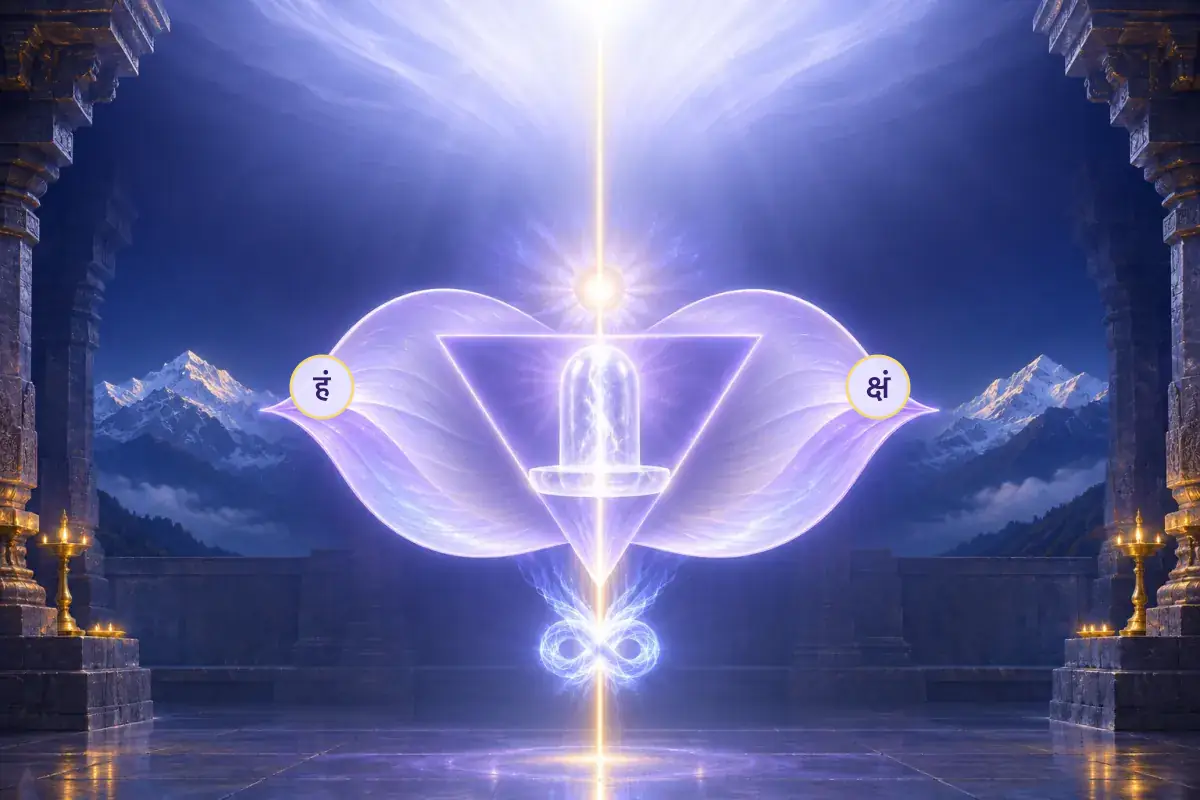
The Ṣaṭ-cakra-nirūpaṇa places the crystalline Itara Liṅga within Ājñā. The Lalitā Sahasranāma names Rudra Granthi here. Release signifies perception beyond separate doership, while discrimination and responsibility remain.
Is OM the bija of Ajna?
Popular teaching commonly gives OṂ. Classical descriptions also contain subtler syllabic and deity structures, and different lineages may assign mantra differently. A public page should therefore explain the common association without pretending one universal practice. Initiated mantra follows the teacher and source.
Third-eye activation versus clear perception
Advertising often equates activation with visions, psychic certainty or pressure in the forehead. Yoga gives a stricter test: does perception become less distorted by fear, craving, memory and ego? A dramatic image may be meaningful, ordinary or misleading. Discernment grows when experience is observed without immediate inflation.
Trataka, Shambhavi and concentration
Trāṭaka, bhrāmarī, mantra, dhāraṇā and śāmbhavī mudrā are often related to this field, but each has its own method and contraindications. Eye strain is not concentration. The gaze remains gentle, and inner attention is supported by posture, breath and ethical steadiness.
A gentle Ajna foundation
Sit with the eyes closed or softly open. Feel the entire face and relax the jaw. Let the breath remain natural. Instead of pushing into the eyebrow point, notice the spacious field behind the forehead in which thoughts, images and sensations appear. Repeat OṂ gently if it belongs to your practice. Finish by grounding in the feet and ordinary surroundings.
When inner perception becomes unreliable
Sleep loss, hyperventilation, migraine, substances, neurological conditions, trauma, mania and psychosis can alter perception. Spiritual meaning and clinical assessment need not be enemies. Persistent voices, paranoia, inability to sleep or function, suicidal thinking or dangerous commands require prompt professional help and suspension of intensive practice.
Buddhi, mind and the witness of thought
We say “my mind is confused” because confusion is known. Yoga uses this direct observation to distinguish the changing field of mind from the awareness that knows it. Ājñā practice gathers manas and strengthens buddhi—the capacity to discriminate—so insight is not merely another compelling thought.
Modern psychology often studies consciousness through mental and neural functions; Yoga may place mind within a wider field of consciousness. These are not solved by slogans. Practice asks the student to examine what changes, what knows change and whether the knowing itself can be seen as an object.
Intuition must be tested in life
A clear intuition tends to be quiet, proportionate and open to verification. Fear-driven certainty is urgent, self-protective and resistant to evidence. Keep a record of an impression, the breath and emotional condition in which it arose, the action taken and the actual outcome. Over time, disciplined comparison reveals projection and genuine sensitivity more honestly than claiming infallibility.
Guru and scripture provide further mirrors. Questioning is not negative in the Indian tradition; sincere inquiry protects truth from imagination.
Where modern science meets this teaching
Trāṭaka, the classical concentration practice for ājñā, has recently been tested in randomised trials. Both found benefits for attention or anxiety, which supports the tradition’s view of this centre as the seat of focused awareness.
- Pandya et al., International Journal of Yoga 2024 — trāṭaka vs relaxation techniques for dental anxiety in children aged 8–11 (randomised, n = 120). After four weeks of training, the trāṭaka group showed a greater fall in anxiety scores and skin-conductance stress responses than the relaxation group. Limit: One clinical setting (dental procedures) in children; it measured anxiety, not inner perception.
- Yadav et al., International Journal of Yoga 2026 — eight weeks of trāṭaka on reaction time and visual perception in young adults (randomised, n = 120). Twenty minutes a day, six days a week, shortened reaction time and reduced susceptibility to an optical illusion compared with no practice. Limit: The control group did nothing, so expectation and attention effects cannot be separated from trāṭaka itself.
How this connects to Swara Yoga
Swara practice refines the conditions of perception. When left and right flows become quiet and balanced, inward concentration may become easier, but balanced airflow is not a certificate of Ājñā awakening. Observe breath, sleep, mood, clarity and conduct together. The purpose is not to collect extraordinary impressions but to see more truthfully.
Learn Trāṭaka with eye-safety limits · Study nāḍī, chakra and granthi
Study the Swara Yoga foundation and see how breath observation connects this subject with daily practice.
Practice, guidance and health
Avoid forceful upward gaze, prolonged candle staring, sleep deprivation, hyperventilation and long retention. People with glaucoma, retinal disease, recent eye surgery, migraine triggered by light, seizure vulnerability, mania, psychosis or severe dissociation need individually adapted or postponed practice. Perceptual disturbance that persists outside practice requires qualified assessment.
What is the right next step for you?
This guided purification suits people who want to work with the chakras gradually, beginning with shuddhi before any activation. It does not promise instant opening or a guaranteed result; practice is prescribed for the person.
Read next: Sahasrara
Swami Charanashrit Giri · Swara Yoga Peeth, Rishikesh
Frequently asked questions
Is the pineal gland the Ajna chakra?
Some modern writers link ājñā with the pineal gland because both are associated with light and lie deep in the head. This is a modern comparison, not a teaching of the classical texts, and there is no evidence that meditation “activates” the pineal gland in the way popular claims suggest.
What is trataka?
Trāṭaka is steady gazing at a small point — often a candle flame — without blinking until the eyes water, then closing them and holding the after-image. The Haṭha Yoga Pradīpikā counts it among the six cleansing actions and says it removes eye ailments and sloth. People with epilepsy, glaucoma or eye disease should seek advice first.
Can third-eye meditation cause headaches?
Yes, if the concentration is forced or held too long, or if the forehead and eyes are tense. Relax the face, soften the gaze and keep sessions short. Persistent headache, visual disturbance or pressure after practice are reasons to stop and, if they continue, to see a doctor.
What is shambhavi mudra?
Śāmbhavī mudrā is gazing gently towards the eyebrow centre, with attention turned inward, often with the eyes half-open. It is praised in Haṭha texts as a seal of Śiva. It should be learnt gradually with guidance, because strain in the eyes defeats its purpose.
Does an open Ajna give psychic powers?
The tradition mentions subtle perceptions and powers but warns repeatedly that chasing them is an obstacle. A mature ājñā shows as clear discernment, steady attention and openness to guidance. Claims of guaranteed psychic powers through ājñā activation should be treated with great caution.
How does Swara Yoga relate to Ajna?
Iḍā and piṅgalā are said to meet at ājñā before the crown. When Swara shows the breath flowing evenly through both nostrils, the conditions for concentration at the brow centre are most favourable. Many teachers advise sitting for ājñā meditation at exactly such times.
Sources
- Ṣaṭ-cakra-nirūpaṇa, Ājñā verses in a named Sanskrit edition.
- Haṭha Yoga Pradīpikā, chapters 2–4, for nāḍī, mudrā and absorption.
- Patañjali, Yoga Sūtra 3.1–3.3, for dhāraṇā, dhyāna and samādhi.
- US NCCIH, Meditation and Mindfulness.
- Ṣaṭ-cakra-nirūpaṇa, verse 32 — Pūrṇānanda, Ṣaṭ-cakra-nirūpaṇa — Sanskrit text and Kālīcaraṇa commentary in Arthur Avalon's 1919 edition.
- Ṣaṭ-cakra-nirūpaṇa, verse 33 — Pūrṇānanda, Ṣaṭ-cakra-nirūpaṇa — orthography normalised from the Sanskrit text and Kālīcaraṇa commentary in Arthur Avalon's 1919 edition.
- Lalitā Sahasranāma Stotram, verse 39 — Śrī Lalitā Sahasranāma Stotram — SanskritDocuments text, proofread by Prof. M. Giridhar, Kirk Wortman and Rajani Arjun Shankar.
- Pandya et al., International Journal of Yoga 2024 — trāṭaka vs relaxation techniques for dental anxiety in children aged 8–11 (randomised, n = 120).
- Yadav et al., International Journal of Yoga 2026 — eight weeks of trāṭaka on reaction time and visual perception in young adults (randomised, n = 120).
Talk to the Peeth about Ajna Chakra
Tell us about your health, your practice and what you are looking for; Swamiji or an Acharya will suggest a path suited to you. Or begin with the free seven-day Swara sheet.
Taught in the lineage of Swami Charanashrit Giri · Swara Yoga Peeth Sansthan, Swargashram, Rishikesh · This page awaits Swamiji’s review · Practice is prescribed for each person, according to their condition.
Continue your study
Explore the complete Seven Chakras teaching, see current courses, or ask which form of guidance suits your experience and safety needs.