Nadi, Chakra and Granthi in Kundalini Yoga
Nadi, chakra and granthi in Kundalini Yoga: Ida, Pingala, Sushumna, subtle centres and knots, source differences, preparation, Swara and safe guidance.
Nadi, Chakra and Granthi in Kundalini Yoga
Nāḍīs are subtle channels, cakras are organised centres and granthis are “knots” described in Yoga and Tantra maps of embodiment. Iḍā, piṅgalā and suṣumṇā are the best-known channels, but texts disagree on the number and arrangement of nāḍīs, cakras and knots. The map is a disciplined contemplative language. It should not be claimed as a hidden anatomical network already proven by medical imaging.
Direct answers to common questions
What are nadis?
Nadis (nāḍī, नाडी) are the subtle channels through which prāṇa flows in the yogic body. The texts count up to 72,000. Three matter most: iḍā on the left, piṅgalā on the right and suṣumṇā in the centre. Swara Yoga reads them directly through the breath: the left nostril, the right, or both together.
What is the sushumna nadi?
Sushumna (suṣumṇā) is the central nāḍī, running from the base of the spine to the crown, between iḍā and piṅgalā. The Haṭha Yoga Pradīpikā gives it many names — the void path, the great path, the middle way. Kuṇḍalinī rises through it, and Swara Yoga recognises it when both nostrils flow evenly.
What are the three granthis?
The three granthis are Brahma, Viṣṇu and Rudra: subtle “knots” that bind consciousness through bodily identity, preserving attachment and separate doership. Lalitā Sahasranāma 38–39 maps their piercing through Mūlādhāra, Maṇipūra and Ājñā; many later teaching maps describe Viṣṇu Granthi through the navel-to-heart field. Haṭha Yoga Pradīpikā says awakened Kuṇḍalinī pierces the knots with the lotuses.
What are the three lingas pierced by Kundalini?
Ṣaṭ-cakra-nirūpaṇa 51 and its commentary name three liṅgas on Kuṇḍalinī’s ascent: Svayambhū Liṅga at Mūlādhāra, Bāṇa Liṅga at Anāhata and Itara Liṅga at Ājñā. They are not anatomical objects. They are sacred forms of Śiva within the contemplative body, met by Śakti as awareness moves from outward speech toward its subtle source.
Still have a question about Nadi, Chakra and Granthi in Kundalini Yoga? Ask in your own words; a teacher of the Peeth replies.
Nāḍī, granthi and liṅga on the ascending path
The channels carry prāṇa, the knots bind consciousness, and the three liṅgas are sacred forms of Śiva encountered by Kuṇḍalinī. They belong to one path but are not the same category.
| Part of the map | Location | Function or importance | Primary textual anchor |
|---|---|---|---|
| Iḍā | Left current; reflected in the left nostril | Lunar, cooling and receptive; Swara uses its flow for calm, nourishing work | Haṭha Yoga Pradīpikā 2.7–10 and the Swara tradition |
| Piṅgalā | Right current; reflected in the right nostril | Solar, warming and active; Swara uses its flow for effort, digestion and decisive work | Haṭha Yoga Pradīpikā 2.7–10 and the Swara tradition |
| Suṣumṇā | Central channel; recognised when both nostrils flow evenly | The middle path through which Kuṇḍalinī ascends; balanced flow favours meditation | Haṭha Yoga Pradīpikā 3.3–4 |
| Brahma Granthi · Svayambhū Liṅga | Mūlādhāra / root passage | The first knot binds awareness to survival and bodily identity; Kuṇḍalinī rests coiled around the root liṅga | Lalitā Sahasranāma 38; Ṣaṭ-cakra-nirūpaṇa 9–11 |
| Viṣṇu Granthi | Maṇipūra in Lalitā Sahasranāma; navel-to-heart field in many later teaching maps | The second knot binds through preservation, role, emotion, attachment and “mine” | Lalitā Sahasranāma 38 |
| Bāṇa Liṅga | Anāhata / heart | Golden Śiva-liṅga with crescent and bindu; the heart passage of devotion, inner sound and Madhyamā speech | Ṣaṭ-cakra-nirūpaṇa 25 and commentary on 51 |
| Rudra Granthi · Itara Liṅga | Ājñā / between the eyebrows | The third knot binds through separate doership and fixed knowing; Itara shines like lightning beside praṇava | Lalitā Sahasranāma 39; Ṣaṭ-cakra-nirūpaṇa 33 |
What the Shastra says
भित्वा लिङ्गत्रयं तत्परमरसशिवे सूक्ष्मधाम्नि प्रदीपे । सा देवी शुद्धसत्त्वा तडिदिव विलसत्तन्तुरूपस्वरूपा ॥ ब्रह्माख्यायाः सिरायाः सकलसरसिजं प्राप्य देदीप्यते । तन्मोक्षाख्यानन्दरूपं घटयति सहसा सूक्ष्मतालक्षणेन ॥
bhitvā liṅgatrayaṃ tatparamarasaśive sūkṣmadhāmni pradīpe | sā devī śuddhasattvā taḍidiva vilasattanturūpasvarūpā || brahmākhyāyāḥ sirāyāḥ sakalasarasijaṃ prāpya dedīpyate | tanmokṣākhyānandarūpaṃ ghaṭayati sahasā sūkṣmatālakṣaṇena ||
Meaning: Having pierced the three liṅgas, the pure-sattva Goddess, subtle as a shining thread and radiant like lightning, reaches and illumines all the lotuses of the channel called Brahma-nāḍī; approaching supreme-bliss Śiva, she brings forth the bliss called liberation.
— Ṣaṭ-cakra-nirūpaṇa, verse 51 · Sanskrit text: Pūrṇānanda, Ṣaṭ-cakra-nirūpaṇa — orthography normalised from the Sanskrit text and Kālīcaraṇa commentary in Arthur Avalon's 1919 edition
The verse says “the three liṅgas”; Kālīcaraṇa’s commentary names them Svayambhū, Bāṇa and Itara and places them respectively at the root, heart and brow. Kuṇḍalinī does not merely pass symbols: she makes a passage through what obstructs the ascent of awareness.
मूलाधारैकनिलया ब्रह्मग्रन्थिविभेदिनी । मणिपूरान्तरुदिता विष्णुग्रन्थिविभेदिनी ॥
mūlādhāraikanilayā brahmagranthivibhedinī | maṇipūrāntaruditā viṣṇugranthivibhedinī ||
Meaning: She whose principal abode is Mūlādhāra pierces Brahma Granthi; rising within Maṇipūra, she pierces Viṣṇu Granthi.
— Lalitā Sahasranāma Stotram, verse 38 · Sanskrit text: Śrī Lalitā Sahasranāma Stotram — SanskritDocuments text, proofread by Prof. M. Giridhar, Kirk Wortman and Rajani Arjun Shankar
This is the clearest compact source for Brahma and Viṣṇu Granthi: the Goddess abides in Mūlādhāra, pierces the first knot, rises within Maṇipūra and pierces the second.
आज्ञाचक्रान्तरालस्था रुद्रग्रन्थिविभेदिनी । सहस्राराम्बुजारूढा सुधासाराभिवर्षिणी ॥
ājñācakrāntarālasthā rudragranthivibhedinī | sahasrārāmbujārūḍhā sudhāsārābhivarṣiṇī ||
Meaning: Dwelling within Ājñā Cakra, she pierces Rudra Granthi; ascending the thousand-petalled lotus, she pours down a stream of nectar.
— Lalitā Sahasranāma Stotram, verse 39 · Sanskrit text: Śrī Lalitā Sahasranāma Stotram — SanskritDocuments text, proofread by Prof. M. Giridhar, Kirk Wortman and Rajani Arjun Shankar
The ascent continues at Ājñā through Rudra Granthi and then into Sahasrāra. The three knots are therefore stages in one movement of Śakti, not separate problems diagnosed by a seller.
Key distinctions
The source matters. The Ṣaṭ-cakra-nirūpaṇa map, Haṭha descriptions and later modern seven-colour charts are related but not identical.
Practice and interpretation
Purification and balance come before force. Breath awareness, nāḍī-śodhana and stable meditation are preparatory; piercing knots is not a beginner visualisation game.
A network of consciousness, not a row of coloured discs
Nāḍī, cakra and granthi describe relationships among prāṇa, mantra, element, sense, deity, attention and identity. Modern diagrams can orient a beginner, but the lived map is dynamic. A centre becomes meaningful through its functions and practice, not merely its colour or location.
The three granthis and three liṅgas
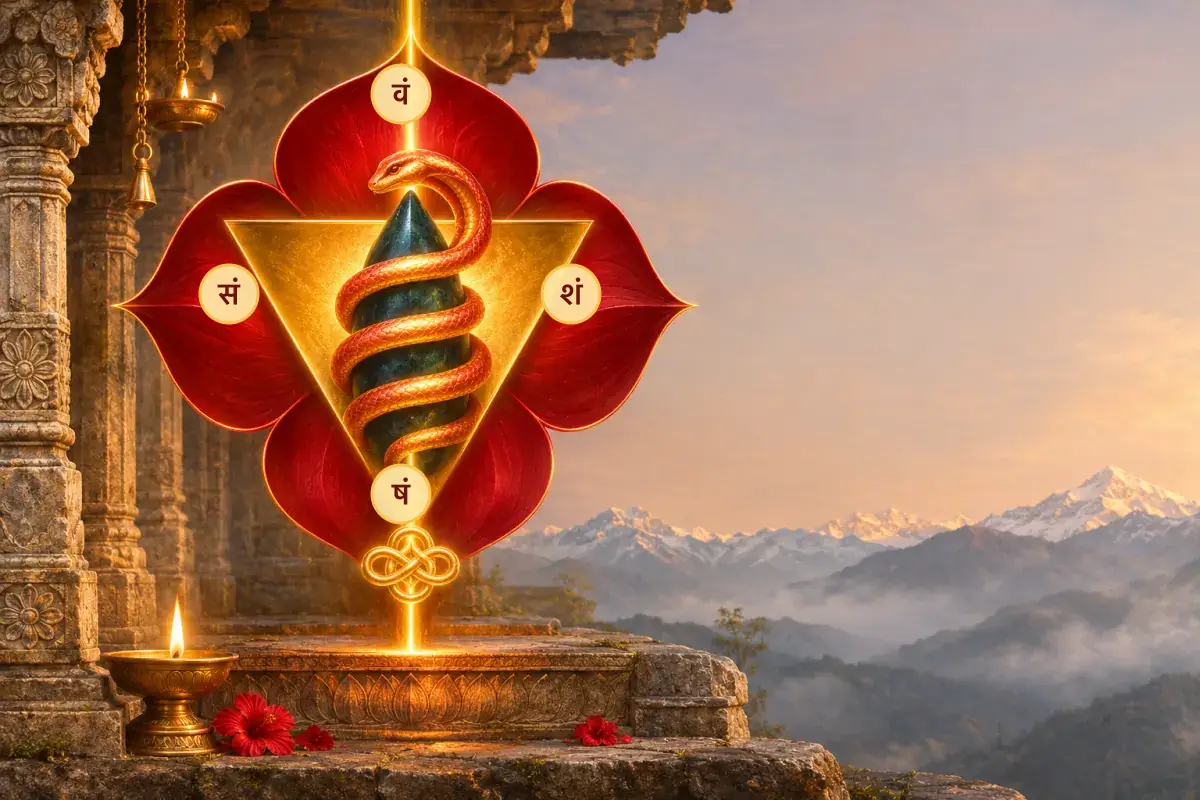
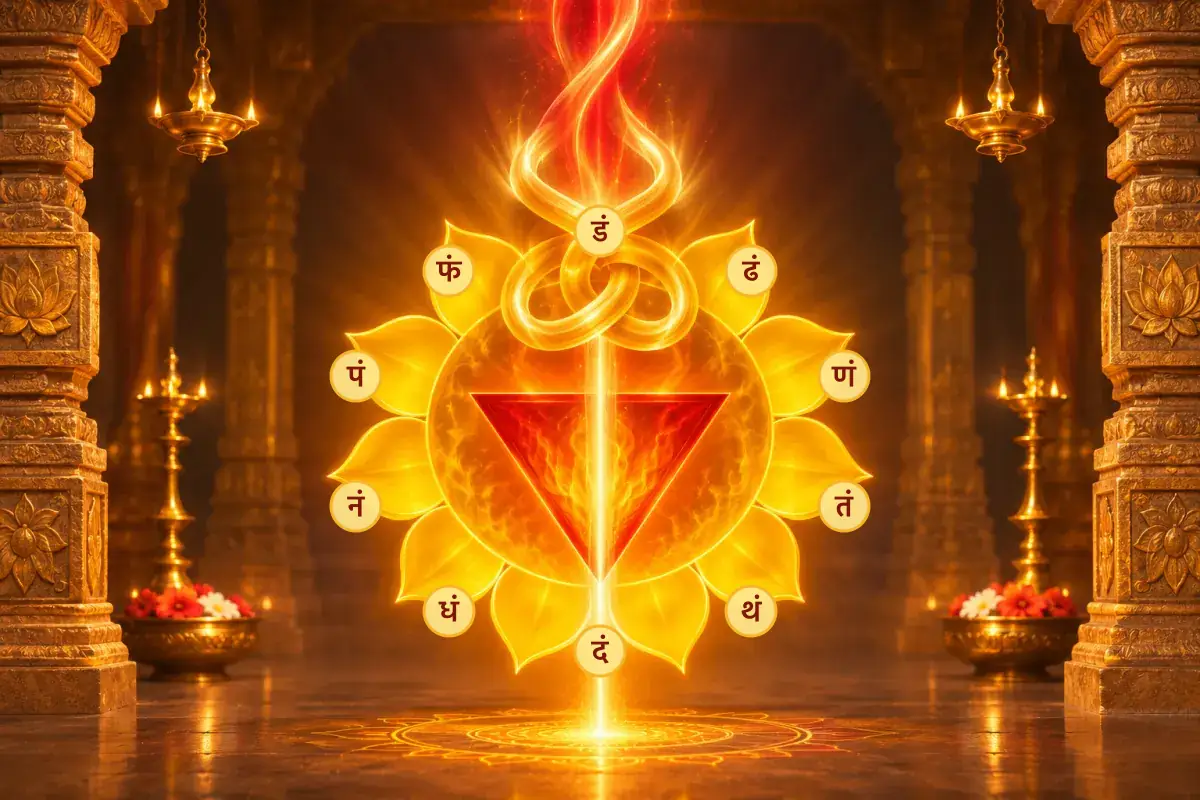
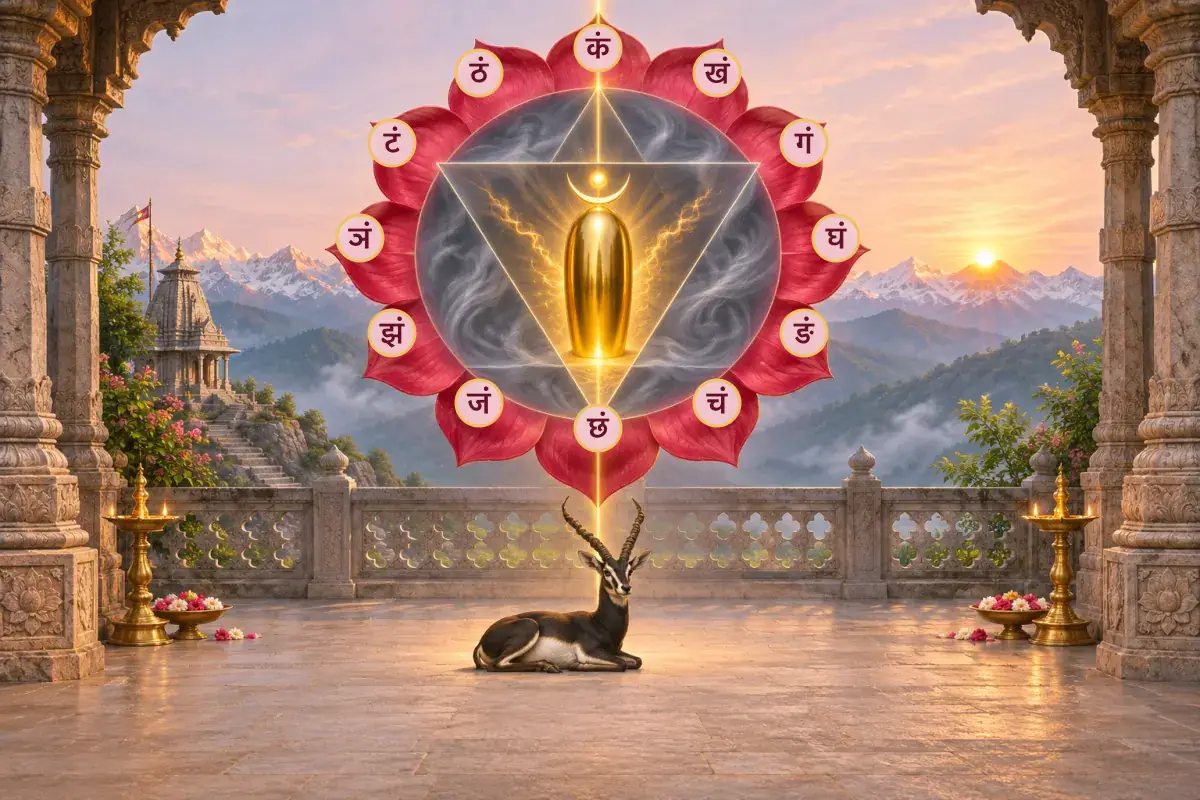
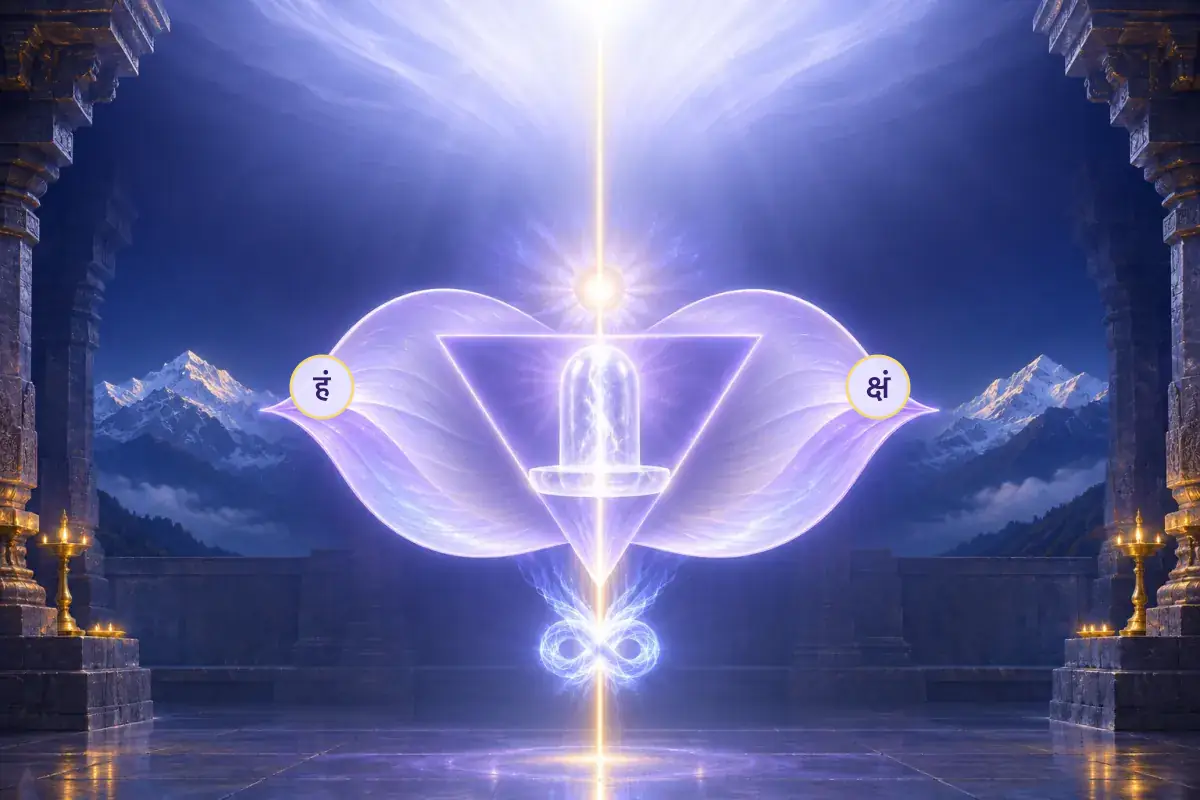
Tradition names Brahmā, Viṣṇu and Rudra granthis as knots of attachment. The Ṣaṭ-cakra-nirūpaṇa names Svayambhū Liṅga at Mūlādhāra, Bāṇa Liṅga at Anāhata and Itara Liṅga at Ājñā. Granthi and liṅga are related but distinct. “Piercing” describes release of contraction, not violent anatomy.
Purification before activation
Nāḍī-śuddhi steadies the pathways through which practice acts; cakra-śuddhi refines the centre’s functioning; granthi-bheda belongs to a deeper process. Advertising instant activation without conduct, preparation and integration reverses the traditional order.
Ida, Pingala and Sushumna organise the central relationship
Iḍā and piṅgalā are commonly presented as lunar and solar currents winding in relation to the central suṣumṇā. They are not simply the left and right sympathetic nerves, although breath, autonomic function and attention interact in embodied practice. Their balance means a workable coordination of complementary functions, not identical airflow every minute. Suṣumṇā becomes meaningful within disciplined inwardness; a brief bilateral nostril flow cannot by itself certify spiritual attainment.
Chakra meanings depend on the text
Texts differ in the number of centres, petals, mantras, deities, elements and locations they emphasise. The familiar seven-chakra rainbow is a useful modern teaching image but not a complete summary of every tantric source. Mūlādhāra through ājñā, bindu and sahasrāra belong to related yet distinct layers of the subtle map. Responsible study names the source rather than declaring one poster to be the universal anatomy of consciousness.
Granthi is contraction, not a physical knot
Brahmā, Viṣṇu and Rudra granthis can be interpreted through attachment to embodiment, emotional and relational identity, knowledge, agency or subtler forms of limitation. “Piercing” a granthi is not tissue manipulation and should never justify violent breath, pressure or spinal force. A knot releases as prāṇa, attention and identity become less bound by the pattern it represents. Conduct and life response help show whether integration is actually occurring.
How chakra shuddhi differs from activation
Śuddhi means clearing, refining and making the centre capable of carrying its function in harmony with the whole. Activation language often implies that a dormant switch can be turned on instantly by another person. Traditional practice instead joins mantra, breath, concentration, deity, element, ethics and preparation over time. A vivid sensation can be acknowledged without being sold as permanent activation. The safer question is whether practice increases clarity, balance and freedom from compulsion.
Reading the network through Swara Yoga
Swara offers a direct, repeatable observation of how breath changes with posture, time, food, emotion and action. This does not make nostril flow a scanner for every chakra. It develops sensitivity to left, right and balanced tendencies and shows how intervention affects the whole person. A practice record—method, duration, Swara before and after, sleep, mood and recovery—gives teacher and student better evidence than memory shaped by expectation.
The network is experienced as relationship
Nāḍī, cakra and granthi become meaningful through relationship: breath meets attention, mantra meets resonance, element meets sense, and personal identity meets a wider field of consciousness. Isolating one centre as though it were a broken mechanical part loses this ecology. Practice asks how the whole field reorganises when one relationship becomes clearer.
A safe order of study
Learn natural breath, posture and ordinary nāḍī observation first. Then study centre symbolism from a named text, add suitable mantra or concentration, and observe the after-effect without chasing imagery. Strong retention, bandha and initiated methods follow readiness. This order does not reduce mystery; it builds the stable instrument through which subtle experience can be known without confusion.
What research can and cannot say
Nāḍī, granthi and liṅga are contemplative structures known through the discipline itself. Research can assess yoga’s methods and safety, not turn this subtle map into anatomy.
- US National Center for Complementary and Integrative Health (NCCIH), “Yoga: Effectiveness and Safety”, last updated August 2023. Calls yoga generally safe for healthy people, notes help for neck pain, anxiety, depression and sleep, and asks pregnant women, older adults and people with conditions such as glaucoma or severe high blood pressure to consult their provider. Limit: A general public-health summary; it does not assess individual traditional methods such as kumbhaka or mudrā.
How this connects to Swara Yoga
Every natural breath offers access to the nāḍī map through changing left, right and balanced flow. Swara Yoga trains observation before intervention so that subtle practice grows from evidence in one’s own breath. Explore the energy network in detail.
Practice, guidance and health
Avoid long retention and forceful locks without supervision, especially with pregnancy, cardiovascular conditions, glaucoma or psychiatric instability.
What is the right next step for you?
This guidance suits steady practitioners who want Kuṇḍalinī or Kriyā practice prepared, dosed and followed up by a teacher. It is not suitable during pregnancy with strong breath work, uncontrolled heart or blood-pressure conditions, or an acute mental-health crisis without medical care.
Read next: Kundalini Kriya
Swami Charanashrit Giri · Swara Yoga Peeth, Rishikesh
Frequently asked questions
Why does Swara Yoga observe the nostrils?
Swara Yoga reads left, right and balanced nostril flow as practical signs of iḍā, piṅgalā and the meditative middle passage. The practitioner does not merely believe this map: they record the changing breath, choose suitable actions and test how each pattern relates to attention, energy and outcome.
Are nadis the same as nerves?
No established one-to-one match exists. Nāḍī means “stream” or “channel” of prāṇa in the subtle body; nerves are anatomical tissue. Some modern writers compare iḍā and piṅgalā with the two branches of the autonomic nervous system, which is a useful bridge for discussion, but the yogic map was drawn from inner observation, not dissection.
How many nadis are there?
The Haṭha Yoga Pradīpikā (1.41) speaks of 72,000 nāḍīs, the figure most teachers quote; other texts give other counts and name a smaller group as principal. Every tradition agrees that iḍā, piṅgalā and suṣumṇā are the three that practice works with directly, and Swara Yoga observes them in every breath.
How do you purify the nadis?
The classical method is nāḍī-śodhana, alternate-nostril breathing practised slowly and daily, supported by a clean diet, regular sleep and, for some people, the cleansing kriyās. The Pradīpikā asks for daily practice with a sāttvic mind. Signs of purified nāḍīs listed in the texts include lightness, a clear voice and steady digestion.
What happens when a granthi opens?
Tradition describes each opening as release from a particular bondage: from narrow bodily identity at Brahma granthi, from emotional attachment at Viṣṇu granthi, and from the sense of a separate doer at Rudra granthi. Experiences can be strong, which is why lineages place each stage under a teacher’s eye.
Is the nadi map the same in every text?
No. The Ṣaṭ-cakra-nirūpaṇa, the Haṭha texts and the Śiva Saṃhitā differ on numbers and details, and modern charts add their own colours. A careful teacher names which text a statement comes from instead of blending all maps into one. The core — three channels, a central path, knots and centres — is shared.
Sources
- Ṣaṭ-cakra-nirūpaṇa.
- Haṭha Yoga Pradīpikā chapters 2–4.
- Śiva Saṃhitā for a distinct subtle-body account.
- Ṣaṭ-cakra-nirūpaṇa, verse 51 — Pūrṇānanda, Ṣaṭ-cakra-nirūpaṇa — orthography normalised from the Sanskrit text and Kālīcaraṇa commentary in Arthur Avalon's 1919 edition.
- Lalitā Sahasranāma Stotram, verse 38 — Śrī Lalitā Sahasranāma Stotram — SanskritDocuments text, proofread by Prof. M. Giridhar, Kirk Wortman and Rajani Arjun Shankar.
- Lalitā Sahasranāma Stotram, verse 39 — Śrī Lalitā Sahasranāma Stotram — SanskritDocuments text, proofread by Prof. M. Giridhar, Kirk Wortman and Rajani Arjun Shankar.
- US National Center for Complementary and Integrative Health (NCCIH), “Yoga: Effectiveness and Safety”, last updated August 2023.
Talk to the Peeth about Nadi, Chakra and Granthi in Kundalini Yoga
Tell us about your health, your practice and what you are looking for; Swamiji or an Acharya will suggest a path suited to you. Or begin with the free seven-day Swara sheet.
Taught in the lineage of Swami Charanashrit Giri · Swara Yoga Peeth Sansthan, Swargashram, Rishikesh · This page awaits Swamiji’s review · Practice is prescribed for each person, according to their condition.
Continue your study
Explore the complete Kundalini Yoga teaching, see current courses, or ask which form of guidance suits your experience and safety needs.