Vishuddha Chakra: Purification through Space, Sound and Truthful Speech
The sixteen-petalled throat centre explained through its textual symbols, mantra, speech discipline, Swara relation and safe practice.
Vishuddha Chakra
Viśuddha or Viśuddhi means especially pure or thoroughly purified. It is the sixteen-petalled throat centre, associated with space (ākāśa), hearing, sound, mantra and the responsibility of speech. Its bīja is HAṂ in the widely used classical presentation.
Purification here does not mean speaking without restraint or diagnosing every throat problem as suppressed truth. It joins listening, silence, accurate speech, mantra, breath and the capacity to let experience be held in a wider inner space.
Direct answers to common questions
What is the Vishuddha chakra?
The Vishuddha chakra is the fifth chakra, at the throat, a sixteen-petalled lotus of the space element (ākāśa) with the seed syllable haṃ. Viśuddha means “especially pure”; the Gorakṣaśataka explains the name through haṃsa, the pure swan of the Self. It governs sound, speech, listening and purification.
Which letters are written on the sixteen petals of Vishuddha?
Ṣaṭ-cakra-nirūpaṇa 28 gives all sixteen Sanskrit vowels, from A through visarga. With bindu as prescribed in the related textual description, our diagram reads clockwise from the top: अं, आं, इं, ईं, उं, ऊं, ऋं, ॠं, ऌं, ॡं, एं, ऐं, ओं, औं, अं, अः. The first अं is A with bindu; the fifteenth is anusvāra, so the two visible forms coincide.
Where is the Vishuddha chakra?
Vishuddha is at the base of the throat, kaṇṭha-mūla in the Ṣaṭ-cakra-nirūpaṇa, along the central channel behind the throat. In practice attention rests in the hollow of the throat, where jālandhara bandha and ujjāyī breathing are felt. Above it lies ājñā, below it the heart centre, anāhata.
What element and bija belong to Vishuddha?
Vishuddha belongs to space (ākāśa), shown as a white circular maṇḍala within sixteen petals bearing the sixteen vowels. Its bīja is haṃ. Its deity is Sadāśiva in the half-male, half-female Ardhanārīśvara form, and its Śakti is Sākinī. Space is the element that makes sound possible.
How do you work with the throat chakra?
The throat chakra is approached through mantra and chanting, ujjāyī breath, gentle jālandhara bandha under guidance, mindful truthful speech and periods of silence (mauna). Listening carefully is as much a viśuddha practice as speaking. Chanting haṃ softly on the exhalation is a simple start.
Still have a question about Vishuddha Chakra? Ask in your own words; a teacher of the Peeth replies.
Viśuddha at a glance
Values from the Ṣaṭ-cakra-nirūpaṇa (Pūrṇānanda), Avalon edition 1919, with the Gorakṣaśataka where it differs.
| Feature | In the texts |
|---|---|
| Location | Base of the throat (kaṇṭha-mūla) |
| Petals | 16, bearing the sixteen vowels |
| Element | Space — white circle (nabho-maṇḍala) |
| Bīja | Haṃ |
| Deity · Śakti | Sadāśiva (Ardhanārīśvara) · Sākinī |
| Different map | Gorakṣaśataka 70 places the water-concentration at the throat |
What the Shastra says
विशुद्धाख्यं कण्ठे सरसिजममलं धूमधूम्रावभासं स्वरैः सर्वैः शोणैर्दलपरिलसितैर्दीपितं दीप्तबुद्धेः । समास्ते पूर्णेन्दुप्रथिततमनभोमण्डलं वृत्तरूपं हिमच्छायानागोपरि लसिततनोः शुक्लवर्णाम्बरस्य ॥
viśuddhākhyaṃ kaṇṭhe sarasijamamalaṃ dhūmadhūmrāvabhāsaṃ svaraiḥ sarvaiḥ śoṇairdalaparilasitairdīpitaṃ dīptabuddheḥ | samāste pūrṇenduprathitatamanabhomaṇḍalaṃ vṛttarūpaṃ himacchāyānāgopari lasitatanoḥ śuklavarṇāmbarasya ||
Meaning: At the throat is the pure smoky-purple Viśuddha lotus. Its petals shine with all sixteen crimson vowels, from A through Visarga; within is the white circular region of space on a snow-white elephant.
— Ṣaṭ-cakra-nirūpaṇa, verse 28 · Sanskrit text: Pūrṇānanda, Ṣaṭ-cakra-nirūpaṇa — Sanskrit text and Kālīcaraṇa commentary in Arthur Avalon's 1919 edition
The verse is the source for Viśuddha’s sixteen vowels and white circular space-maṇḍala; the commentary states that the sequence begins with A and ends with visarga.
विशब्दः संस्मृतो हंसो निर्मलः शुद्ध उच्यते । अतः कण्ठे विशुद्धाख्ये चक्रं चक्रविदो विदुः ॥
viśabdaḥ saṃsmṛto haṃso nirmalaḥ śuddha ucyate | ataḥ kaṇṭhe viśuddhākhye cakraṃ cakra-vido viduḥ ||
Meaning: The syllable “vi” is understood as haṃsa, and the spotless is called “śuddha”; therefore the knowers of the cakras know the cakra in the throat as viśuddha.
— Gorakṣaśataka, verse 62 · Sanskrit text: Gorakṣaśataka — GRETIL e-text (Göttingen) of the critical edition by Swami Kuvalayananda and S. A. Shukla (Kaivalyadham, Lonavla)
The name is unpacked: “vi” stands for haṃsa, the pure, and “śuddha” for the spotless. The throat centre is where speech becomes purified awareness.
विशुद्धे परमे चक्रे धृत्वा सोमकलाजलम् । मासेन न क्षयं याति वञ्चयित्वा मुखं रवेः ॥
viśuddhe parame cakre dhṛtvā soma-kalā-jalam | māsena na kṣayaṃ yāti vañcayitvā mukhaṃ raveḥ ||
Meaning: Holding the nectar of the moon-digit in the supreme viśuddha cakra, and so evading the mouth of the sun, the yogī does not decline even in a month.
— Gorakṣaśataka, verse 63 · Sanskrit text: Gorakṣaśataka — GRETIL e-text (Göttingen) of the critical edition by Swami Kuvalayananda and S. A. Shukla (Kaivalyadham, Lonavla)
Holding the moon’s nectar at viśuddha, the text says, protects from decline. This links the throat centre with khecarī and the preservation of vitality — practices given only with guidance.
Meaning, position and sixteen petals
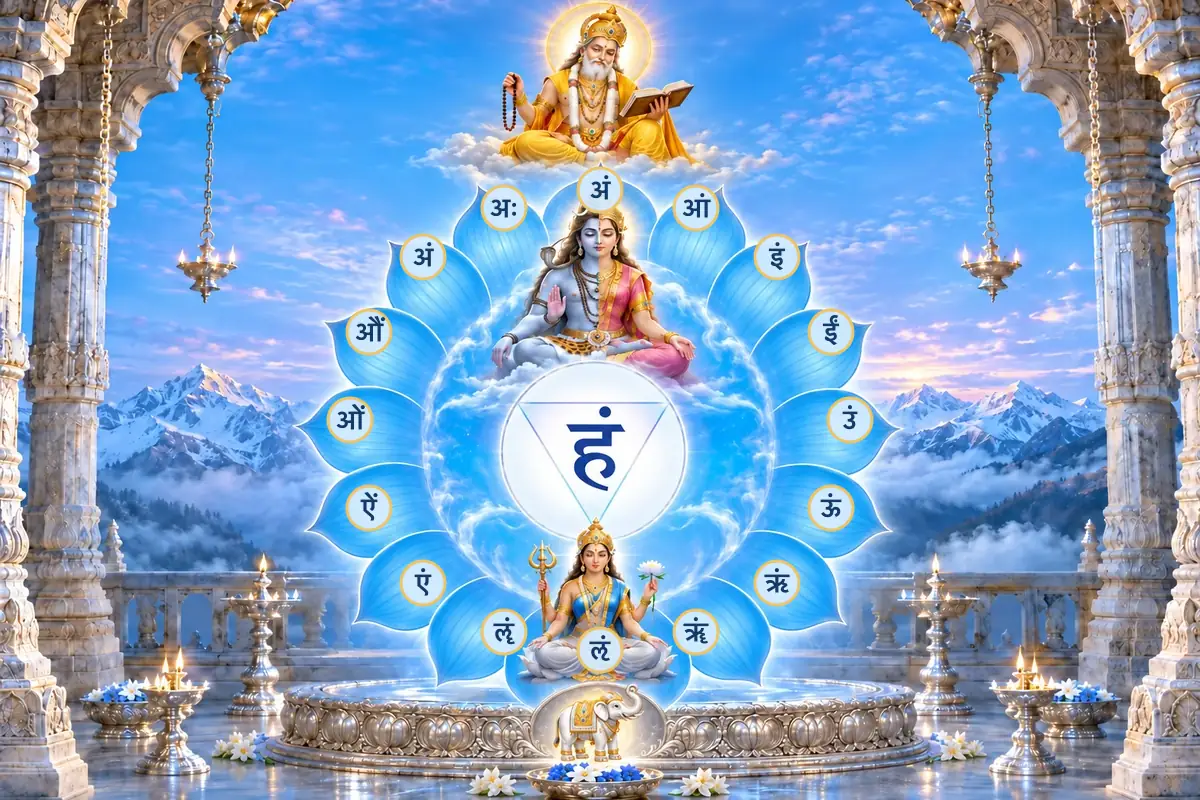
The lotus is contemplated in the throat region along suṣumṇā. Its sixteen petals are linked with the Sanskrit vowels in the Ṣaṭ-cakra-nirūpaṇa presentation. The white space maṇḍala, bīja HAṂ, Sadāśiva and Śākinī establish a symbolic field of resonance and purification. It remains a subtle centre, not the thyroid gland under another name.
Akasha is the condition for sound
Space accommodates without becoming the objects it contains. Sound unfolds through a medium and hearing receives it. Viśuddha therefore concerns not only speaking but the inner room in which sensation, thought and other people can be heard without immediate reaction.
Speech is a yogic action
Truthfulness (satya) is more than saying whatever arises. Yogic speech considers accuracy, necessity, timing and non-harm. Silence may protect truth, or it may hide fear; speech may liberate, or it may discharge agitation. Purification means recognising the force carried by words.
Mantra, vibration and listening
Mantra joins sound, breath, attention, meaning, deity and lineage. Feeling vibration in the throat can support concentration, but vibration alone is not proof of initiation or cure. Pronunciation and dosage matter, and some mantras are public while others belong to transmission.
Jalandhara Bandha and Ujjayi
The throat participates in jālandhara bandha and ujjāyī, but neither should be reduced to a chakra hack. Forceful chin pressure, narrowed breathing or long retention can strain the neck, throat and cardiovascular system. A teacher adjusts the angle, effort and duration to the person.
A gentle Vishuddha practice
Sit comfortably with the neck long, not rigid. Hum softly on exhalation and feel vibration without pushing volume. After several rounds, rest in listening: first outer sound, then the quieter field in which sound appears. Finish by choosing one truthful and kind sentence that needs to be spoken—or one unnecessary sentence that can be released.
From expression to spacious awareness
As attention becomes subtler, sound is not merely something “I produce.” Mantra and nāda reveal consciousness as the field in which vibration, listener and meaning arise together. This mystical opening grows through sustained discipline, not louder chanting or a purchased activation.
The sixteen vowels and the subtle field of language
Vowels carry voiced sound with relatively open passage and allow consonants to become audible speech. Their placement on the sixteen petals gives Viśuddha a profound relation to the matrix of language. Tantra does not treat letters as arbitrary marks alone; mantra practice recognises sound as a graded expression of power and consciousness.
This does not make every Sanskrit syllable a universal therapy. Pronunciation, intention, sequence and transmission shape practice. The symbolism invites reverence for language and the responsibility to avoid turning sacred sound into empty branding.
Listening is as important as speaking
A throat-centre teaching that focuses only on self-expression remains incomplete. Hearing is the sense of ākāśa, and listening allows another reality to enter without immediate defence. In daily sādhanā, pause before answering, feel the breath that will carry speech, and ask whether the words are true, useful and timely.
As this discipline matures, silence is no longer suppression and speech is no longer discharge. Both become conscious actions serving relationship, teaching and truth.
From heart resonance to Ajna discrimination
Viśuddha stands between the relational heart and the discerning command centre. What is felt at Anāhata must pass through the purification of language before it can become clear understanding and responsible action. An emotion spoken too quickly may distort truth; an insight never embodied in speech may remain private imagination.
This middle function is visible in study and teaching. The practitioner receives a text, listens to commentary, asks questions, recites accurately and then expresses the understanding in conduct. Sound becomes a bridge from experience to knowledge. Purification therefore includes admitting uncertainty, correcting a mistake and refusing to use spiritual vocabulary to conceal confusion.
Where modern science meets this teaching
Chanting is the classical practice of viśuddha, and it is also one of the most researched. Rhythmic recitation slows breathing and synchronises heart rhythm, and OM chanting has been linked with quieter emotional brain regions.
- Kalyani BG et al., International Journal of Yoga 2011 — functional MRI of audible “OM” chanting (12 healthy volunteers, NIMHANS). Chanting OM was associated with deactivation of limbic regions including the amygdala, which did not occur when volunteers pronounced “ssss”. Limit: A pilot of twelve people; the authors suggest, but do not show, a clinical use.
- Bernardi L et al., BMJ 2001 — rosary prayer and yoga mantras and autonomic cardiovascular rhythms (23 healthy adults). Reciting a mantra or the Ave Maria slowed breathing to about six breaths a minute, synchronised cardiovascular rhythms and raised baroreflex sensitivity. Limit: A small laboratory study of healthy volunteers; it measured breathing rhythm effects, not the meaning or power of mantra in a tradition.
How this connects to Swara Yoga
Breath carries speech, and its quality changes the force of words. Swara Yoga asks the practitioner to notice whether breath is hot, hurried, weak, balanced or naturally inward before speaking or chanting. Ujjāyī and mantra are selected according to condition; a dry, irritated or anxious throat is not helped by more force.
Read the complete Ujjāyī guide · Understand purification before activation
Study the Swara Yoga foundation and see how breath observation connects this subject with daily practice.
Practice, guidance and health
Do not force the glottis, voice, chin lock or breath retention. Stop for pain, marked dizziness, air hunger or panic. Persistent hoarseness, swallowing difficulty, neck swelling or breathing symptoms need medical assessment. Mantra and humming should remain comfortable; initiated practice follows its lineage.
What is the right next step for you?
This guided purification suits people who want to work with the chakras gradually, beginning with shuddhi before any activation. It does not promise instant opening or a guaranteed result; practice is prescribed for the person.
Read next: Ajna Chakra
Swami Charanashrit Giri · Swara Yoga Peeth, Rishikesh
Frequently asked questions
Why is the throat chakra linked with truth?
Because speech is the outward expression of the mind, and the tradition holds that truthful speech (satya) purifies it. Lies and harsh words create inner conflict; honest, kind speech brings steadiness. Viśuddha practice therefore includes ethics of speech, not only breath and mantra.
What is ujjayi breath and how does it relate to Vishuddha?
Ujjāyī is breathing with a slight narrowing at the glottis, producing a soft ocean-like sound. It keeps attention at the throat, slows the breath and is used with jālandhara bandha in many practices. It should stay gentle; strain in the throat or neck means the effort is too strong.
Can throat problems mean a blocked Vishuddha?
Hoarseness, thyroid problems, sore throat or difficulty swallowing are medical matters first and should be assessed by a doctor. The tradition’s descriptions of viśuddha imbalance — difficulty speaking truth, not listening — are for reflection, not diagnosis. Practice is prescribed for the person and their condition.
What is jalandhara bandha?
Jālandhara bandha is the chin lock: the chin lowered towards the chest to seal the throat during breath retention. It is one of the ten mudrās of the Haṭha Yoga Pradīpikā. It is learnt with a teacher, and avoided or modified with neck problems, high blood pressure or heart disease.
How does silence help the throat chakra?
Mauna, silence for a set time, lets the energy normally spent in speech settle and turns attention to listening — outwardly to others and inwardly to subtle sound. Many practitioners keep an hour or a day of silence each week. It should be chosen freely and kept with kindness to those around you.
How does Swara Yoga relate to Vishuddha?
Swara recognises the ākāśa tattva, the space element, as a particular phase of the breath, suited to meditation rather than worldly action in the texts. Chanting or sitting in silence when this phase is noticed links Swara directly with the throat centre’s element and purpose.
Sources
- Ṣaṭ-cakra-nirūpaṇa, Viśuddha verses in a named Sanskrit edition.
- Haṭha Yoga Pradīpikā, chapters 2–4, for prāṇāyāma, bandha and nāda.
- Patañjali, Yoga Sūtra 2.30–2.36 for ahiṃsā and satya.
- US NCCIH, Yoga: What You Need to Know.
- Ṣaṭ-cakra-nirūpaṇa, verse 28 — Pūrṇānanda, Ṣaṭ-cakra-nirūpaṇa — Sanskrit text and Kālīcaraṇa commentary in Arthur Avalon's 1919 edition.
- Gorakṣaśataka, verse 62 — Gorakṣaśataka — GRETIL e-text (Göttingen) of the critical edition by Swami Kuvalayananda and S. A. Shukla (Kaivalyadham, Lonavla).
- Gorakṣaśataka, verse 63 — Gorakṣaśataka — GRETIL e-text (Göttingen) of the critical edition by Swami Kuvalayananda and S. A. Shukla (Kaivalyadham, Lonavla).
- Kalyani BG et al., International Journal of Yoga 2011 — functional MRI of audible “OM” chanting (12 healthy volunteers, NIMHANS).
- Bernardi L et al., BMJ 2001 — rosary prayer and yoga mantras and autonomic cardiovascular rhythms (23 healthy adults).
Talk to the Peeth about Vishuddha Chakra
Tell us about your health, your practice and what you are looking for; Swamiji or an Acharya will suggest a path suited to you. Or begin with the free seven-day Swara sheet.
Taught in the lineage of Swami Charanashrit Giri · Swara Yoga Peeth Sansthan, Swargashram, Rishikesh · This page awaits Swamiji’s review · Practice is prescribed for each person, according to their condition.
Continue your study
Explore the complete Seven Chakras teaching, see current courses, or ask which form of guidance suits your experience and safety needs.