Chandra Namaskar (Moon Salutation): the 14 Steps, the Crescent and When to Practise
The fourteen positions of the Bihar School Moon Salutation, the crescent lunge that makes it lunar, how it differs from the Sun Salutation, and when the lunar practice serves you.
Chandra Namaskar
Chandra Namaskar (चन्द्र नमस्कार, candra namaskāra), the Moon Salutation, is the lunar counterpart of the Sun Salutation: a slower sequence for the evening or for a heated, restless state. In the Bihar School form it has fourteen positions — the twelve of the Sun Salutation with Ardha Chandrāsana, the crescent lunge, after each lunge — and a full round of twenty-eight.
Direct answers to common questions
What are the steps of Chandra Namaskar?
The fourteen steps are prayer pose, raised arms, forward fold, lunge, crescent, mountain, eight-limb salute, cobra, mountain, lunge, crescent, forward fold, raised arms and prayer pose. They are the Sun Salutation’s twelve with Ardha Chandrāsana, the crescent, added after each lunge. The other leg leads in the second half.
What is the difference between Surya and Chandra Namaskar?
Chandra Namaskar is the slower, cooling counterpart of Surya Namaskar. It adds the crescent lunge twice, giving fourteen positions instead of twelve, and is practised in the evening rather than at sunrise. The Sun Salutation warms and energises; the Moon Salutation calms, lengthens the front of the body and settles the mind.
When should Chandra Namaskar be practised?
The evening is the traditional time, especially near the full moon, and any hour when the body or mind feels overheated. It needs a stomach two to three hours after food. Because it is quietening, it is a good bridge between a busy day and sleep, done slowly with soft breath.
How many rounds of Chandra Namaskar should I do?
Three to five slow full rounds are enough for most people; each full round has twenty-eight positions, both legs included. Hold the crescent for a few breaths if it is comfortable. Count less and feel more: the practice works through slowness, so fewer careful rounds give more than many hurried ones.
Still have a question about Chandra Namaskar? Ask in your own words; a teacher of the Peeth replies.
What the Shastra says
आदित्यो ह वै प्राणो रयिरेव चन्द्रमाः । रयिर्वा एतत्सर्वं यन् मूर्तं चामूर्तं च । तस्मान् मूर्तिरेव रयिः ॥
ādityo ha vai prāṇo rayir eva candramāḥ | rayir vā etat sarvaṃ yan mūrtaṃ cāmūrtaṃ ca | tasmān mūrtir eva rayiḥ ||
Meaning: The sun is prāṇa, the life-breath; the moon is rayi, the substance that is fed. All this — whatever has form and whatever is formless — is rayi; therefore form itself is rayi.
— Praśna Upaniṣad 1.5 · Sanskrit text: Praśna Upaniṣad with Śaṅkara’s commentary — GRETIL e-text (Göttingen), opened 2026-11-28 by the wellness audit
The Upaniṣad pairs the sun as prāṇa, the life-force, with the moon as rayi, the nourished substance of form. The two salutations follow that pairing: one awakens energy, the other settles and nourishes the body.
चन्द्रः स्त्री पुरुषः सूर्यश्चन्द्रो गौरोऽसितो रविः । चन्द्रनाडीप्रवाहेण सौम्यकार्याणि कारयेत् ॥
candraḥ strī puruṣaḥ sūryaścandro gauro'sito raviḥ | candranāḍīpravāheṇa saumyakāryāṇi kārayet ||
Meaning: The moon is feminine and the sun masculine; the moon is fair, the sun dark. While the lunar nāḍī flows, gentle and steady works should be done.
— Śiva Svarodaya, verse 60 · Sanskrit text: Śiva Svarodaya — sanskritdocuments.org edition, collated with the Swara Yoga Peeth corpus (Muktibodhānanda, Bihar School of Yoga)
Gentle and steady work belongs to the lunar flow. The Moon Salutation is that kind of work in movement, and it is best done when the left nostril is open.
The 14 positions of the Moon Salutation
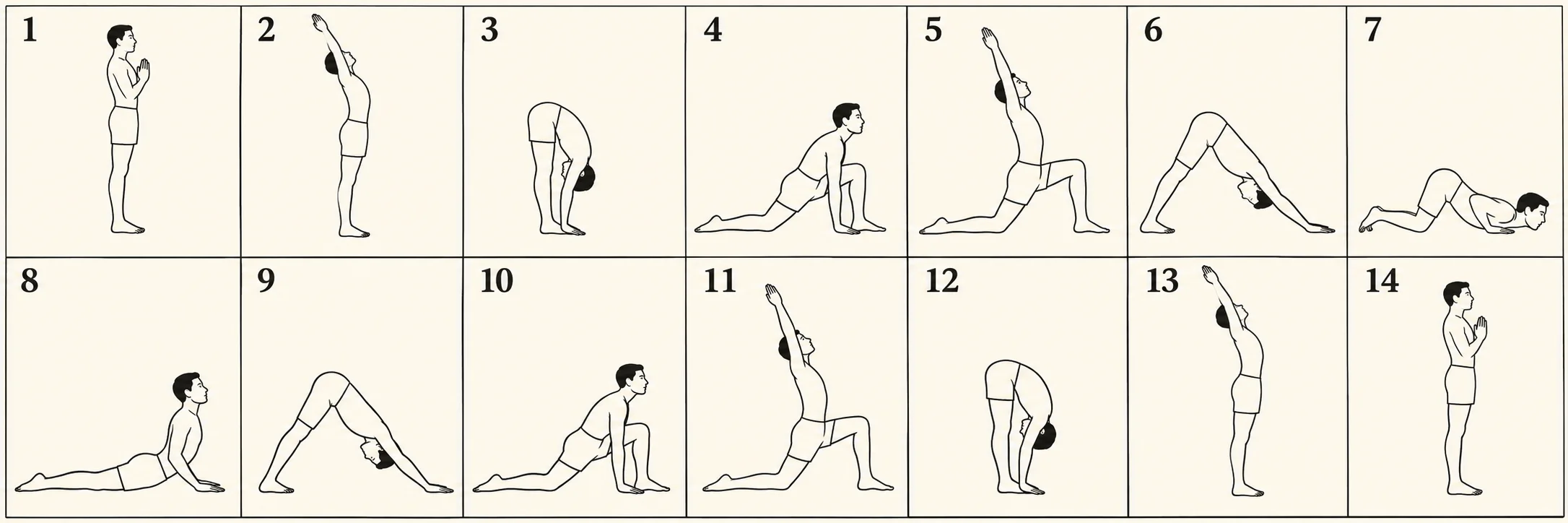
- Praṇāmāsana — palms joined at the chest.
- Hasta Uttānāsana — arms raised overhead.
- Pādahastāsana — forward fold.
- Aśva Sañcālanāsana — one leg steps back into a low lunge.
- Ardha Chandrāsana — from the lunge, raise the arms and arch gently: the crescent moon.
- Parvatāsana — hips lifted into the mountain.
- Aṣṭāṅga Namaskāra — knees, chest and chin lowered.
- Bhujaṅgāsana — the cobra.
- Parvatāsana — back to the mountain.
- Aśva Sañcālanāsana — the same leg comes forward.
- Ardha Chandrāsana — the crescent once more.
- Pādahastāsana — forward fold.
- Hasta Uttānāsana — arms raised.
- Praṇāmāsana — return to stillness.
The crescent lunge and the 28-position round
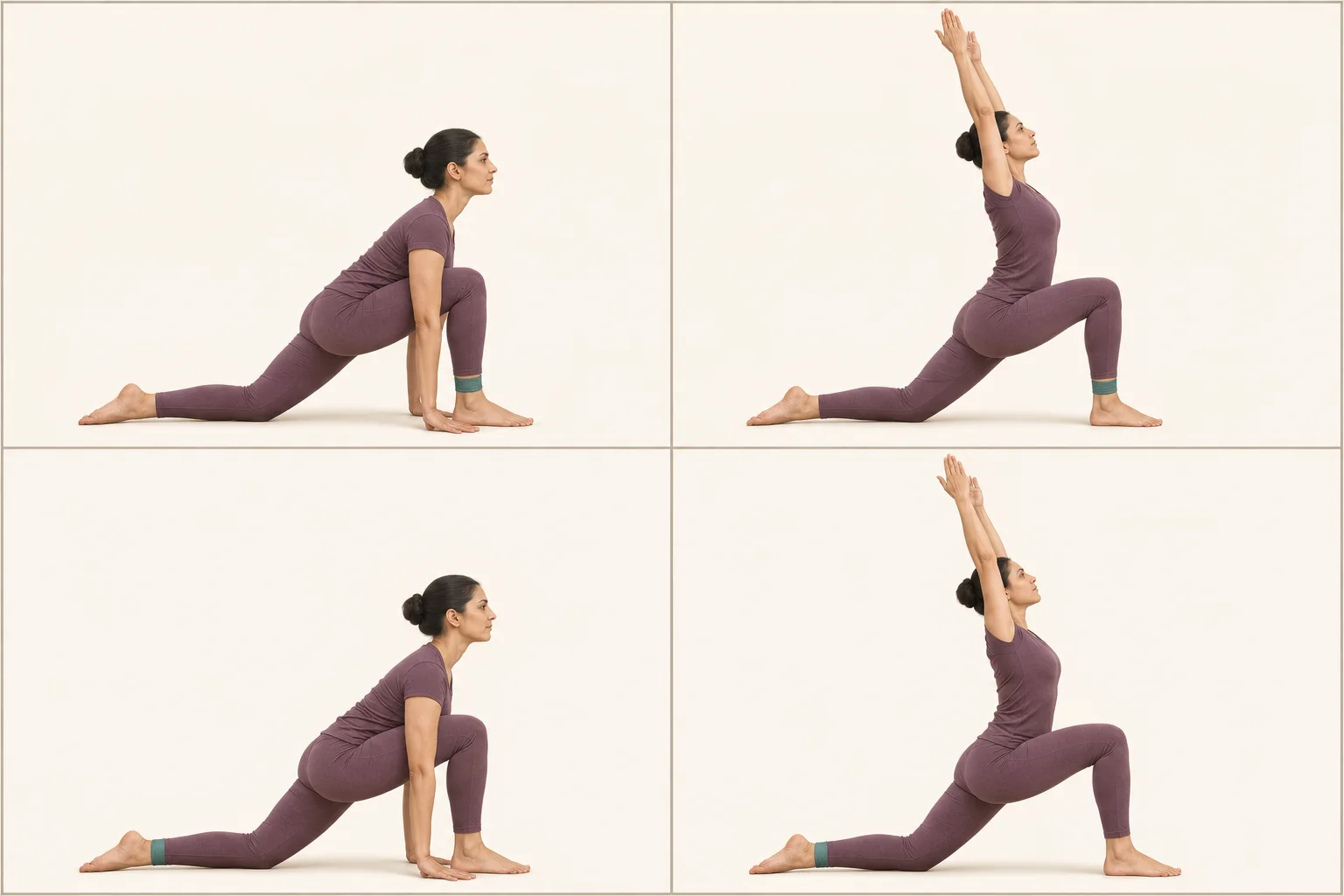
The crescent is what makes the sequence lunar. From the lunge the arms rise and the front of the body lengthens like the curve of a new moon, then the hands return to the floor. In the second half of the round the other leg steps back, so a full round has twenty-eight positions and two crescents on each side.
How it differs from the Sun Salutation
The Sun Salutation is brisk and warming, best at sunrise. The Moon Salutation is done slowly, often with longer pauses and softer breath, in the evening, on a full-moon night, or whenever heat, anger or overwork needs cooling. Several modern schools use the same name for a different, standing sequence of side bends and wide-legged postures; that is a separate practice. This page describes the fourteen-position form of the Bihar School of Yoga, and your teacher will say which form they teach.
Who it suits and how it is adapted
Its slower rhythm suits people who tire easily, people with a fiery temperament and anyone winding down at the end of the day. The adaptations are those of the Sun Salutation: no deep forward folds with a slipped disc, a low cobra and a shallow crescent with a lordotic back, support for the wrists and knees, and a standing version in pregnancy. Three to five slow full rounds are enough to feel its effect.
When to practise the Moon Salutation
The Bihar School teaches the Moon Salutation for the evening, as the quieter partner of the Sun Salutation done at sunrise. It suits the end of a working day, hot weather and the days when the body needs cooling rather than heat. Practise it on an empty stomach, slowly, with long exhalations, and finish with a few minutes of rest lying on the back. In Swara terms it fits the left, lunar flow.
Who should not practise Chandra Namaskar?
- Anyone who has not yet learnt the Sun Salutation — learn Sūrya Namaskār first; the postures are the same except for one. (Bihar School of Yoga, Asana Pranayama Mudra Bandha, p. 175)
- High blood pressure, coronary heart disease or a past stroke — the semi-inverted positions overstrain a weak heart; practise slow breathing and gentle standing postures instead. (Bihar School of Yoga, Asana Pranayama Mudra Bandha, p. 179, as for Sūrya Namaskār, p. 163)
- Hernia, intestinal tuberculosis or peptic ulcer — leave the round out until the condition has settled. (Bihar School of Yoga, Asana Pranayama Mudra Bandha, p. 163, 171)
- Slipped disc, sciatica, knee or ankle problems — a back-care programme serves better; keep the crescent lunge short with the back knee resting on a blanket. (Bihar School of Yoga, Asana Pranayama Mudra Bandha, p. 163, 168)
- Fever, acute inflammation, boils or rashes — pause and resume once the body is clear. (Bihar School of Yoga, Asana Pranayama Mudra Bandha, p. 163)
- The first days of menstruation, pregnancy beyond the twelfth week, the first forty days after childbirth — resume towards the end of the period, or about forty days after delivery. (Bihar School of Yoga, Asana Pranayama Mudra Bandha, p. 163)
Stop at once if you feel dizziness, chest pain, palpitations, or sharp pain in the back or knees: come out slowly, lie on the back and breathe quietly.
What research can and cannot say
The Peeth’s evidence dossier records no controlled study of the Moon Salutation itself. What research shows for yoga programmes in general — benefit with regular practice, injury mainly with forcing — applies to it, and the page teaches its method from the Bihar School manual.
- US National Center for Complementary and Integrative Health (NCCIH), “Yoga: Effectiveness and Safety”, last updated August 2023. Calls yoga generally safe for healthy people, notes help for neck pain, anxiety, depression and sleep, and asks pregnant women, older adults and people with conditions such as glaucoma or severe high blood pressure to consult their provider. Limit: A general public-health summary; it does not assess individual traditional methods such as kumbhaka or mudrā.
- Cramer H, Krucoff C, Dobos G, PLoS One 2013 — systematic review of 76 published cases of adverse events associated with yoga. Forceful breathing, headstand, shoulder stand and lotus were the practices most often named; the authors advise beginners to avoid extreme practices and patients with glaucoma to avoid inversions. Limit: Case reports show what can happen, not how often; most of the millions who practise never appear in such reports.
How this connects to Swara Yoga
Śiva Svarodaya assigns gentle, steady work to the lunar flow, when the left nostril is open. The Moon Salutation is that work in movement. Practise it in the evening and notice the nostril before and after; a shift towards the left, or towards an even flow, is the sign the cooling has reached the breath. When the solar flow has run long through a heated day, these rounds help restore the balance.
Practising Chandra Namaskar safely
Practise two to three hours after a meal, slowly, on a non-slip surface. The crescent loads the front knee and the lower back, so keep the back knee padded and the arch shallow until it is comfortable. Stop with dizziness or pain, and choose the standing version in pregnancy or after surgery.
What is the right next step for you?
Courses suit people who want a steady, step-by-step practice with a teacher, online or at the ashram in Rishikesh. A general course is not the right first step for a specific health condition or an acute crisis; that needs practice prescribed for the person’s state.
Read next: Yoga Asanas
Swami Charanashrit Giri · Swara Yoga Peeth, Rishikesh
Frequently asked questions
Is the Moon Salutation a traditional practice?
The sun and the moon are paired throughout yoga and its texts, but a Moon Salutation sequence is recent. The fourteen-position form described here was taught by the Bihar School of Yoga in the twentieth century. It applies the old lunar principle to the modern salutation, which is why the Peeth teaches it beside the Sun Salutation.
Is there a mantra for Chandra Namaskar?
The Bihar School manual gives a mantra for each position, as the sun’s names are recited in Surya Namaskar, while other teachers simply keep the breath slow and silent. The Peeth teaches the mantra in person, so that pronunciation is learnt correctly. Without a mantra, attention to the cool, quiet breath already makes the practice lunar.
Can beginners do the Moon Salutation?
Yes, if they can already do the Sun Salutation comfortably. The crescent adds a backward arch and more work for the front knee, so beginners keep it shallow, pad the back knee and hold it only for a breath. Learning the twelve sun positions first makes the fourteen moon positions easy to follow.
Why is the crescent lunge called Ardha Chandrāsana here?
Ardha Chandrāsana means half-moon pose, and the curved line of the raised arms and lengthened body in the lunge resembles a crescent. Other schools use the same name for a standing balance on one leg. In the Moon Salutation it always means the kneeling crescent lunge with arms raised.
Can Chandra Namaskar help with sleep?
Many students find that a few slow rounds in the evening make it easier to settle into sleep, because the pace slows the breath and releases the day’s tension. Finish with a few minutes lying in rest. If sleep problems are persistent, a teacher can suggest a fuller evening routine suited to the cause.
Who should avoid the Moon Salutation?
Those who should avoid the full Sun Salutation should also avoid this one: a slipped disc, severe high blood pressure, glaucoma, recent surgery and injured wrists or knees. The crescent adds strain for a lordotic lower back, which keeps the arch minimal. In pregnancy a standing, gentle version replaces the floor positions.
Sources
- Swami Satyananda Saraswati, Asana Pranayama Mudra Bandha (Bihar School of Yoga, Munger) — Chandra Namaskara.
- Praśna Upaniṣad and Śiva Svarodaya — verses quoted above, from the editions named beside each verse.
- Haṭha Yoga guide · Āsana.
- Praśna Upaniṣad 1.5 — Praśna Upaniṣad with Śaṅkara’s commentary — GRETIL e-text (Göttingen), opened 2026-11-28 by the wellness audit.
- Śiva Svarodaya, verse 60 — Śiva Svarodaya — sanskritdocuments.org edition, collated with the Swara Yoga Peeth corpus (Muktibodhānanda, Bihar School of Yoga).
- US National Center for Complementary and Integrative Health (NCCIH), “Yoga: Effectiveness and Safety”, last updated August 2023.
- Cramer H, Krucoff C, Dobos G, PLoS One 2013 — systematic review of 76 published cases of adverse events associated with yoga.
Talk to the Peeth about Chandra Namaskar
Tell us about your health, your practice and what you are looking for; Swamiji or an Acharya will suggest a path suited to you. Or begin with the free seven-day Swara sheet.
Taught in the lineage of Swami Charanashrit Giri · Swara Yoga Peeth Sansthan, Swargashram, Rishikesh · This page awaits Swamiji’s review · Practice is prescribed for each person, according to their condition.
Continue your study
Explore the complete Hatha Yoga teaching, see current courses, or ask which form of guidance suits your experience and safety needs.