Surya Namaskar (Sun Salutation): the 12 Steps, the Mantras and a Full Round
Each of the twelve positions with its breath, how the Peeth counts a full round of twenty-four, the sun mantras, and how the sequence is adapted for each body.
Surya Namaskar
Surya Namaskar (सूर्य नमस्कार, sūrya namaskāra), the Sun Salutation, is a flowing sequence of twelve postures linked with the breath and, traditionally, a mantra to the sun at each step. At Swara Yoga Peeth twelve positions make a half round; repeating them with the other leg stepping back at the fourth position completes one full round of twenty-four.
Direct answers to common questions
What are the 12 steps of Surya Namaskar?
The twelve steps are prayer pose, raised arms, forward fold, lunge, plank, eight-limb salute, cobra, mountain pose, lunge, forward fold, raised arms and prayer pose again. The sequence returns through its own steps like a mirror, so positions nine to twelve repeat positions four to one in reverse order.
How many rounds of Surya Namaskar should a beginner do?
Two or three slow full rounds are enough at the start, with one breath held in each position. Add a round a week as long as the breath stays easy and nothing hurts. Twelve full rounds is the traditional morning measure for a healthy, practised body, reached over months.
What is the best time to do Surya Namaskar?
Sunrise, facing east, on an empty stomach is the traditional time, when the salutation greets the rising sun. Early morning also suits the body: the sequence loosens stiff joints and wakes the breath. If mornings are impossible, practise before a meal at any hour, but not just before sleep.
What are the benefits of Surya Namaskar?
Done regularly, the sequence stretches and strengthens the whole body, links movement with breath and leaves the mind alert. Practitioners report better flexibility, posture and morning energy. Its effect depends on pace: slow rounds steady the mind, while brisk rounds work the heart and lungs like moderate exercise.
Still have a question about Surya Namaskar? Ask in your own words; a teacher of the Peeth replies.
Surya Namaskar mantras: the twelve names of the sun
One name is recited with each position, silently or aloud. Some traditions use six seed syllables instead, each heard twice in a half round.
| Position | Mantra | Seed syllable |
|---|---|---|
| 1 Praṇāmāsana | Oṃ Mitrāya namaḥ | Oṃ hrāṃ |
| 2 Hasta Uttānāsana | Oṃ Ravaye namaḥ | Oṃ hrīṃ |
| 3 Pādahastāsana | Oṃ Sūryāya namaḥ | Oṃ hrūṃ |
| 4 Aśva Sañcālanāsana | Oṃ Bhānave namaḥ | Oṃ hraiṃ |
| 5 Santolanāsana | Oṃ Khagāya namaḥ | Oṃ hrauṃ |
| 6 Aṣṭāṅga Namaskāra | Oṃ Pūṣṇe namaḥ | Oṃ hraḥ |
| 7 Bhujaṅgāsana | Oṃ Hiraṇyagarbhāya namaḥ | Oṃ hrāṃ |
| 8 Parvatāsana | Oṃ Marīcaye namaḥ | Oṃ hrīṃ |
| 9 Aśva Sañcālanāsana | Oṃ Ādityāya namaḥ | Oṃ hrūṃ |
| 10 Pādahastāsana | Oṃ Savitre namaḥ | Oṃ hraiṃ |
| 11 Hasta Uttānāsana | Oṃ Arkāya namaḥ | Oṃ hrauṃ |
| 12 Praṇāmāsana | Oṃ Bhāskarāya namaḥ | Oṃ hraḥ |
What the Shastra says
विश्वरूपं हरिणं जातवेदसं परायणं ज्योतिरेकं तपन्तम् । सहस्ररश्मिः शतधा वर्तमानः प्राणः प्रजानामुदयत्येष सूर्यः ॥
viśvarūpaṃ hariṇaṃ jātavedasaṃ parāyaṇaṃ jyotir ekaṃ tapantam | sahasraraśmiḥ śatadhā vartamānaḥ prāṇaḥ prajānām udayaty eṣa sūryaḥ ||
Meaning: Of every form, golden, knower of all that is born, the final support, the one light that gives heat: with a thousand rays, turning in a hundred ways, the life-breath of all creatures — here rises the sun.
— Praśna Upaniṣad 1.8 · Sanskrit text: Praśna Upaniṣad with Śaṅkara’s commentary — GRETIL e-text (Göttingen), opened 2026-11-28 by the wellness audit
The Upaniṣad calls the rising sun “the life-breath of all creatures”. This is why the salutation is made at sunrise: it greets the source of prāṇa itself, and the mantras keep that meaning alive in the movement.
सूर्यनाडीप्रवाहेण रौद्रकर्माणि कारयेत् । सुषुम्नायाः प्रवाहेण भुक्तिमुक्तिफलानि च ॥
sūryanāḍīpravāheṇa raudrakarmāṇi kārayet | suṣumnāyāḥ pravāheṇa bhuktimuktiphalāni ca ||
Meaning: While the solar nāḍī flows, demanding and vigorous works should be done; with the flow of suṣumṇā come the fruits of worldly fulfilment and liberation.
— Śiva Svarodaya, verse 61 · Sanskrit text: Śiva Svarodaya — sanskritdocuments.org edition, collated with the Swara Yoga Peeth corpus (Muktibodhānanda, Bihar School of Yoga)
Swara Yoga sets vigorous work in the solar flow. A dynamic salutation to the sun belongs naturally to the time when the right, solar nostril is open — and often helps open it.
The 12 positions of Surya Namaskar
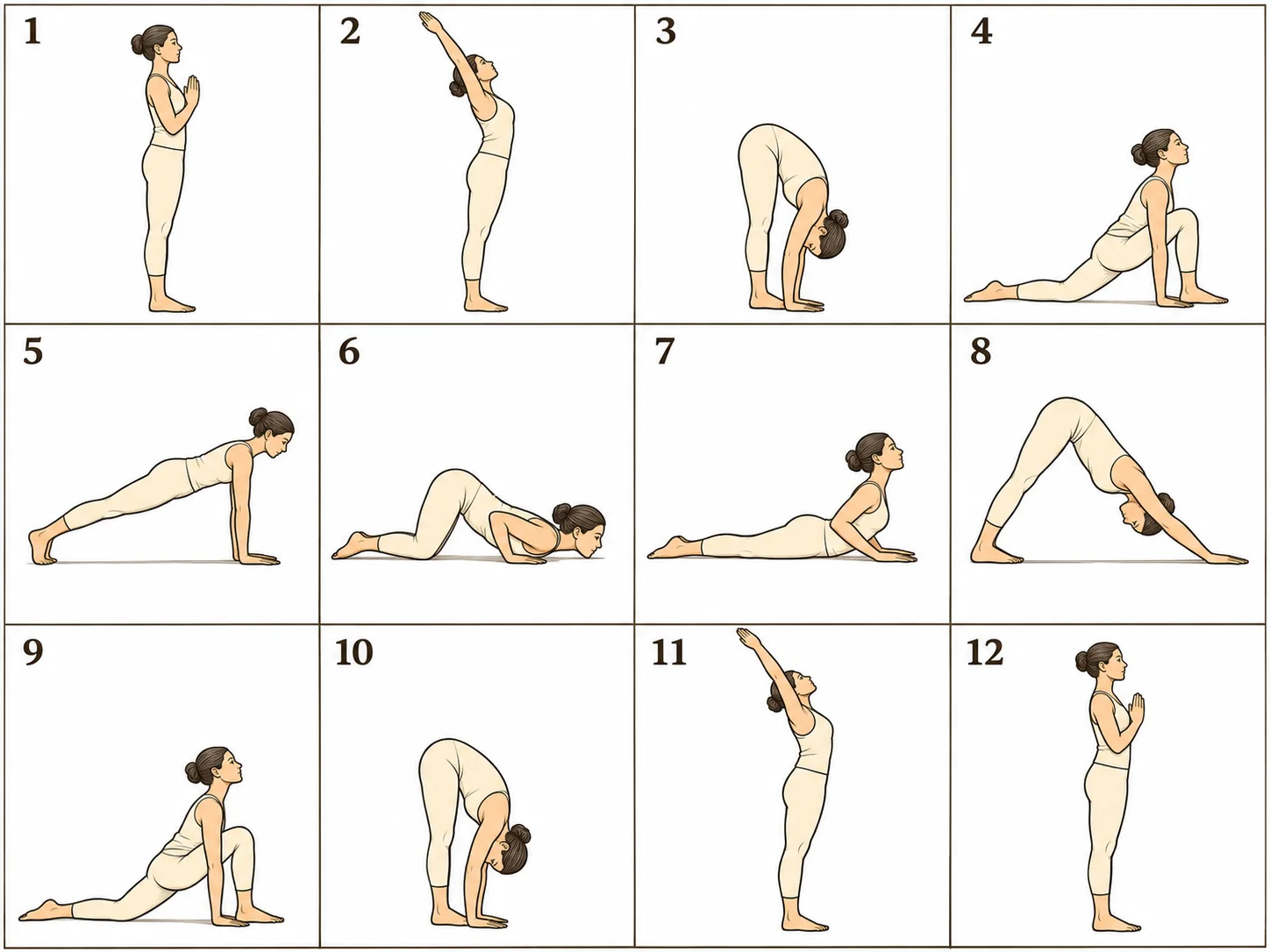
- Praṇāmāsana — stand tall, palms joined at the chest.
- Hasta Uttānāsana — raise the arms overhead and open the chest gently.
- Pādahastāsana — fold forward from the hips, hands beside the feet.
- Aśva Sañcālanāsana — step one leg back into a low lunge, gaze forward.
- Santolanāsana — bring the other leg back into a plank; the body forms one straight line.
- Aṣṭāṅga Namaskāra — lower knees, chest and chin, hips slightly raised: the salute with eight points touching the floor.
- Bhujaṅgāsana — slide forward and lift the chest into the cobra.
- Parvatāsana — lift the hips into the mountain, an inverted V.
- Aśva Sañcālanāsana — bring the foot that stepped back first forward between the hands.
- Pādahastāsana — bring the other foot forward and fold.
- Hasta Uttānāsana — rise with the arms overhead.
- Praṇāmāsana — return to standing with palms joined.
Breath and the two common orders
The breath follows the shape of the body: inhale as the chest opens or the arms rise, exhale as the body folds or lowers, and keep it natural in the eight-limb salute. This is the order of the Yoga Certification Board of the Ministry of Ayush; the Bihar School of Yoga uses the mountain pose at position five instead of the plank.
Half round and full round: how the Peeth counts 24
In the Peeth’s counting the twelve positions are a half round. The second half repeats them with the other leg stepping back at position four. Both halves make one full round of twenty-four positions, so both sides of the body work equally. Some schools count twelve positions as a round and change legs in the next.
What is classical and what is modern
Saluting the rising sun with its names is an old Vedic act of worship; the Upaniṣads call the sun the life-breath of all creatures. The flowing sequence of twelve postures is younger: it does not appear in the Haṭha Yoga Pradīpikā or the Gheraṇḍa Saṃhitā and took its present form in twentieth-century India. The Peeth teaches both layers: the movement trains body and breath, the mantra keeps it a salutation.
Pace, rounds and adapting it to your body
Begin with two or three slow full rounds and add rounds over weeks. Slow rounds build steadiness; brisk rounds warm the body. Twelve full rounds is a traditional morning measure for a practised body. Weak wrists bear weight on the fists; a lordotic lower back keeps the cobra low.
Who should not practise Surya Namaskar?
- High blood pressure, heart disease or a past stroke — the semi-inverted positions strain the heart; practise the joint-freeing series instead. (Bihar School of Yoga, Asana Pranayama Mudra Bandha, p. 163)
- Hernia, intestinal tuberculosis, peptic ulcer or an overactive thyroid — leave the round out until the condition settles. (Bihar School of Yoga, Asana Pranayama Mudra Bandha, p. 163, 171)
- Slipped disc, sciatica, knee or ankle problems — a back-care programme serves better; otherwise fold only from the hips and keep the lunge short. (Bihar School of Yoga, Asana Pranayama Mudra Bandha, p. 163, 167, 168)
- Glaucoma or an ear infection — keep the head above the heart and leave out the deep folds and mountain pose. (Bihar School of Yoga, Asana Pranayama Mudra Bandha, p. 17, 167)
- Fever, acute inflammation, boils or rashes — pause until the body is clear. (Bihar School of Yoga, Asana Pranayama Mudra Bandha, p. 163)
- Early menstruation, pregnancy after the twelfth week, the forty days after childbirth — resume later in the period, or about forty days after delivery. (Bihar School of Yoga, Asana Pranayama Mudra Bandha, p. 163)
Stop at once if you feel dizziness, chest pain, palpitations or sharp pain: lie down, breathe quietly, and return another day with fewer, slower rounds.
Where modern science meets this teaching
One laboratory study compared the Sun Salutation directly with cycling, and wider research on yoga programmes shows the benefits and cautions the tradition already teaches: gains in fitness and wellbeing, and injuries mainly when practice is forced.
- Sinha B et al., Indian Journal of Physiology and Pharmacology 2013 — Sūrya Namaskār compared with bicycle exercise at similar energy use (20 experienced yoga instructors). At the same energy expenditure, heart rate, ventilation and carbon-dioxide output were lower in the Sun Salutation than on the bicycle; the authors conclude its cardiorespiratory stress is lower. Limit: Twenty experienced instructors in a laboratory; it measured effort, not health outcomes or benefit for beginners.
- US National Center for Complementary and Integrative Health (NCCIH), “Yoga: Effectiveness and Safety”, last updated August 2023. Calls yoga generally safe for healthy people, notes help for neck pain, anxiety, depression and sleep, and asks pregnant women, older adults and people with conditions such as glaucoma or severe high blood pressure to consult their provider. Limit: A general public-health summary; it does not assess individual traditional methods such as kumbhaka or mudrā.
- Cramer H, Krucoff C, Dobos G, PLoS One 2013 — systematic review of 76 published cases of adverse events associated with yoga. Forceful breathing, headstand, shoulder stand and lotus were the practices most often named; the authors advise beginners to avoid extreme practices and patients with glaucoma to avoid inversions. Limit: Case reports show what can happen, not how often; most of the millions who practise never appear in such reports.
How this connects to Swara Yoga
Śiva Svarodaya assigns vigorous, demanding work to the solar flow, when the right nostril is open. The Sun Salutation is that kind of work, and it is traditionally done at sunrise facing east. Notice which nostril flows before you begin and again after six rounds; often the right nostril has opened and the mind has woken.
Learn the Swara Yoga foundation · How the flowing nostril changes
Practising Surya Namaskar safely
Practise on an empty stomach, on a non-slip surface, within a range you can control; the list above says who adapts the round and how.
What is the right next step for you?
Courses suit people who want a steady, step-by-step practice with a teacher, online or at the ashram in Rishikesh. A general course is not the right first step for a specific health condition or an acute crisis; that needs practice prescribed for the person’s state.
Read next: Chandra Namaskar
Swami Charanashrit Giri · Swara Yoga Peeth, Rishikesh
Frequently asked questions
Is Surya Namaskar described in the Haṭha Yoga Pradīpikā?
No. Neither the Haṭha Yoga Pradīpikā nor the Gheraṇḍa Saṃhitā contains the twelve-position sequence; it took its present form in twentieth-century India. Worship of the rising sun with its names is far older and is honoured in the Upaniṣads. The Peeth teaches the modern sequence with the old mantras, so both layers stay alive.
Should the Surya Namaskar mantras be chanted aloud?
Either way is correct. Beginners often say each name aloud in the pause before moving, which slows the pace and fixes the order. Experienced students repeat the name silently while the breath moves. Learn the pronunciation from a teacher first, since a mantra repeated wrongly for years is hard to correct.
Can Surya Namaskar be done during pregnancy?
The Bihar School manual allows it with care until the start of the twelfth week. After that the lunges, the eight-limb salute and the cobra press on the abdomen, so a teacher gives a standing salutation with arm and side movements instead. After childbirth the round begins again at about forty days.
Does Surya Namaskar help with weight loss?
Brisk rounds raise the heart rate and use energy, so regular practice supports weight control together with diet and sleep. Slow rounds do less for energy use and more for steadiness. The Peeth treats the salutation as part of a daily routine, not a quick fix.
Which leg goes back first in Surya Namaskar?
Schools differ: the Bihar School of Yoga steps the right leg back first, and the Yoga Certification Board begins with the left. In the Peeth’s full round the second half always uses the other leg. What matters is that both sides receive equal repetitions.
Can Surya Namaskar be done in the evening?
It can, on an empty stomach, but its warming, awakening effect may make sleep harder if done late. For evenings the Moon Salutation, slower and cooling, is the traditional choice. If you practise the Sun Salutation after work, keep the rounds slow and finish with a few minutes of rest lying down.
Sources
- Praśna Upaniṣad and Śiva Svarodaya — verses quoted above, from the editions named beside each verse.
- Yoga Certification Board, Ministry of Ayush, Government of India — Surya Namaskar guide (positions).
- Swami Satyananda Saraswati, Asana Pranayama Mudra Bandha (Bihar School of Yoga, Munger) — Surya Namaskara: the twelve solar names and the six seed syllables.
- Haṭha Yoga guide · Āsana · Chandra Namaskar.
- Praśna Upaniṣad 1.8 — Praśna Upaniṣad with Śaṅkara’s commentary — GRETIL e-text (Göttingen), opened 2026-11-28 by the wellness audit.
- Śiva Svarodaya, verse 61 — Śiva Svarodaya — sanskritdocuments.org edition, collated with the Swara Yoga Peeth corpus (Muktibodhānanda, Bihar School of Yoga).
- Sinha B et al., Indian Journal of Physiology and Pharmacology 2013 — Sūrya Namaskār compared with bicycle exercise at similar energy use (20 experienced yoga instructors).
- US National Center for Complementary and Integrative Health (NCCIH), “Yoga: Effectiveness and Safety”, last updated August 2023.
- Cramer H, Krucoff C, Dobos G, PLoS One 2013 — systematic review of 76 published cases of adverse events associated with yoga.
Talk to the Peeth about Surya Namaskar
Tell us about your health, your practice and what you are looking for; Swamiji or an Acharya will suggest a path suited to you. Or begin with the free seven-day Swara sheet.
Taught in the lineage of Swami Charanashrit Giri · Swara Yoga Peeth Sansthan, Swargashram, Rishikesh · This page awaits Swamiji’s review · Practice is prescribed for each person, according to their condition.
Continue your study
Explore the complete Hatha Yoga teaching, see current courses, or ask which form of guidance suits your experience and safety needs.